I have written mostly of the positive aspects that come with moving to China; whether they are inherently positive or just amusing is a separate issue, but, either way, The China Diaries portions of Thought's Dowinion have mostly shied away from anything serious. Moving to another country, I knew there would be struggles. That's part of the deal. That's even part of the appeal.
I do seem to be having a rather rough time of it this week. If you were to ask me right now if I'm glad I came to China, the answer would be "Yes." If you were to ask me right now if I'm happy here, the answer would be somewhat less certain. There are many reasons for this, some that will change and others that are less likely to do so. It is, I'm sure, cyclical.
I realized today that I have not hugged anyone in 40 days. Outside of a handshake, I haven't had any sort of physical contact with another human being since 4 September. And, lest there be misunderstanding, I mean that in a completely platonic way. I miss hugging friends goodbye. I miss laying my head in a friend's lap while watching a movie. I miss the feeling that there's someone there. That's the hardest part. You're alone in ways you didn't expect, because, if you're lucky, you've never experienced them before.
Thursday, October 13, 2011

The China Diaries: The Small Successes
I made mention in a previous post of my difficulties in expressing that simplest of statements, "I can't speak Chinese." I have exciting news, beloved readers.
I climbed into a taxi tonight, to go home from my weekly Chinese lesson. I told the man where to take me, and he asked me a follow up question which I didn't understand.
“对不起”, I said. Pronounced 'dui bu qi,' it's "I'm sorry." This part has always worked. Never once had a problem with the ole 对不起. (Well, besides the fact that I constantly mix it up with 'bu ke qi,' which is "You're welcome."). The part that comes next is the trouble spot, but I need to learn somehow, so I gathered up my courage and said what has failed so many times before: "我不会说中文". ('Wo bu hui shuo zhong wen,' literally "I am unable to speak Chinese.") I braced myself for the look of incomprehension and the further attempts to communicate with me. Sometimes they pat you on the knee, as though you will understand what they are saying through absorption.
A miracle happened; the cab driver smiled, and nodded, clearly having understood. I ventured further. "我只会说 ('wo zhi hui shuo', "I can only speak")," and then I held up my hand with my fingers close together. That he held up his hand with his fingers in the same position as I did told me that he understood everything. It was a good, if very quiet, cab ride home after that.
* * * * *
Except for the part where he called another driver the Chinese equivalent of a "cunt." That part was loud.
I climbed into a taxi tonight, to go home from my weekly Chinese lesson. I told the man where to take me, and he asked me a follow up question which I didn't understand.
“对不起”, I said. Pronounced 'dui bu qi,' it's "I'm sorry." This part has always worked. Never once had a problem with the ole 对不起. (Well, besides the fact that I constantly mix it up with 'bu ke qi,' which is "You're welcome."). The part that comes next is the trouble spot, but I need to learn somehow, so I gathered up my courage and said what has failed so many times before: "我不会说中文". ('Wo bu hui shuo zhong wen,' literally "I am unable to speak Chinese.") I braced myself for the look of incomprehension and the further attempts to communicate with me. Sometimes they pat you on the knee, as though you will understand what they are saying through absorption.
A miracle happened; the cab driver smiled, and nodded, clearly having understood. I ventured further. "我只会说 ('wo zhi hui shuo', "I can only speak")," and then I held up my hand with my fingers close together. That he held up his hand with his fingers in the same position as I did told me that he understood everything. It was a good, if very quiet, cab ride home after that.
* * * * *
Except for the part where he called another driver the Chinese equivalent of a "cunt." That part was loud.
Saturday, October 8, 2011
The China Diaries: Post
It only took a month, but I've finally mailed some letters. As it turns out, there's a China Post office just down the street. I had been repeatedly told that it was "across the street" from my apartment, which was not exactly helpful; when you're in an apartment block, there are four across the streets, and they are each, you know, a full block. (A Chinese block is much longer than an American block)
It was a surprisingly painless process, really, though I felt a lot of anxiety walking up to the door. It must have been all the waiting, because this is something I haven't so much put off as simply not gotten to; it's the band-aid I've elected to remove slowly.
I walked up to the counter with the sign "Stamp Ccunter". Seemed a safe bet. While I waited for the person in front of me to finish their transaction, I pulled out my dictionary and looked up "Stamp". (邮票)
The moment I found it, the woman at the counter looked over and asked me, "邮票?"
"Uh, 是,邮票." (If I barely knew what was going on, I'm not giving you an advantage)
She pointed to the "Letters&Pa rcels" counter, spoke quickly to the men behind it, and went back to whatever she was doing.
There was a gentleman in front of me here as well, being helped by the two men. One of them was busy dealing with the customer while the other looked on. After a few minutes, the less busy of the two looked over at me.
I smiled, which seems to be a permanent condition when you're in a country where you don't speak the language. "Smile at them," your instincts tell you, "lest they decide you are to be feared."
"您好。Uh... 邮票?"
He responded in quite a bit of Chinese. I smiled and replied "I'm sorry, I don't speak that much Chinese." (Pinning down how to say this in Chinese has proven remarkably tricky. I have asked several people, and they all give me different answers. The first thing they teach you in Spanish class is "Yo hablo español," which is really just propagating a lie at that point, but at least it's not a large leap to "Yo no hablo español." I know how to say neither in Chinese, which is really getting embarrassing.)
He considered me a moment, and gently offered "Please wait a moment." He didn't speak English, but his pronunciation in that sentence was better than mine. Someone's been practicing.
I had three letters; One to go to England, one to go to the United States, and one to go to France. When it was my turn, I handed them to the man at the computer, offering "英国,美国,法国" as my best explanation. When I receive letters from other people here, the envelope has my address scribbled in Chinese on it, so Mr. Postman (Hey!) knows where to drop the letter. I figure outgoing mail doesn't need more than a knowledge of the country of destination. Leave it to their respective postal companies to sort the rest out. Just get it on the plane. I paid the man ¥18, and went on my way.
A simple outing, but it was affirming. The big stuff is easy because the school has people to help us; phones, medical issues, etc. The little things are left to us, as well they should be. It's a great feeling when you figure something out. I have a stack of 10 letters sitting on my desk at work, waiting. They will have to wait but one day more, and they will be on their way.
It was a surprisingly painless process, really, though I felt a lot of anxiety walking up to the door. It must have been all the waiting, because this is something I haven't so much put off as simply not gotten to; it's the band-aid I've elected to remove slowly.
I walked up to the counter with the sign "Stamp Ccunter". Seemed a safe bet. While I waited for the person in front of me to finish their transaction, I pulled out my dictionary and looked up "Stamp". (邮票)
The moment I found it, the woman at the counter looked over and asked me, "邮票?"
"Uh, 是,邮票." (If I barely knew what was going on, I'm not giving you an advantage)
She pointed to the "Letters&Pa rcels" counter, spoke quickly to the men behind it, and went back to whatever she was doing.
There was a gentleman in front of me here as well, being helped by the two men. One of them was busy dealing with the customer while the other looked on. After a few minutes, the less busy of the two looked over at me.
I smiled, which seems to be a permanent condition when you're in a country where you don't speak the language. "Smile at them," your instincts tell you, "lest they decide you are to be feared."
"您好。Uh... 邮票?"
He responded in quite a bit of Chinese. I smiled and replied "I'm sorry, I don't speak that much Chinese." (Pinning down how to say this in Chinese has proven remarkably tricky. I have asked several people, and they all give me different answers. The first thing they teach you in Spanish class is "Yo hablo español," which is really just propagating a lie at that point, but at least it's not a large leap to "Yo no hablo español." I know how to say neither in Chinese, which is really getting embarrassing.)
He considered me a moment, and gently offered "Please wait a moment." He didn't speak English, but his pronunciation in that sentence was better than mine. Someone's been practicing.
I had three letters; One to go to England, one to go to the United States, and one to go to France. When it was my turn, I handed them to the man at the computer, offering "英国,美国,法国" as my best explanation. When I receive letters from other people here, the envelope has my address scribbled in Chinese on it, so Mr. Postman (Hey!) knows where to drop the letter. I figure outgoing mail doesn't need more than a knowledge of the country of destination. Leave it to their respective postal companies to sort the rest out. Just get it on the plane. I paid the man ¥18, and went on my way.
A simple outing, but it was affirming. The big stuff is easy because the school has people to help us; phones, medical issues, etc. The little things are left to us, as well they should be. It's a great feeling when you figure something out. I have a stack of 10 letters sitting on my desk at work, waiting. They will have to wait but one day more, and they will be on their way.
Friday, October 7, 2011
The China Diaries: Neat Little Rows
I spent a decent portion of the National Holiday week in my apartment, reading and watching Game of Thrones (really just great, by the way). On the last day, I went East to see the Terracotta Army.
You are, I'm sure, at least familiar with the concept of the Te rracotta Army. In 1974, farmers in Shaanxi province were attempting to dig a well when they stumbled upon a terracotta soldier buried in the ground. Curious about the find, but still in need of a well, they moved a few feet to the left, and dug again, only to strike another soldier. This process continued for several more hours until, finally frustrated by the utter lack of success, the farmers reported the discovery to the authorities. The incident report read, "Can you get these things out of here? We're trying to dig a well."
I went with another teacher who'd been here a year without ever managing to visit the warriors. This is not, it turns out, so unusual; the Assistant Director of Studies at my school has been here for four years, and he hasn't visited them. He tells me he will go to see them on his last day, before going to the airport. At this point it's a matter of principle.
Damian and I met around 10:30, traveling into the city center to catch a bus. Adjacent you'll see a picture of part of Xi'an's wall. Like most places in this part of China, Xi'an is famous for its wall. I await the day when I learn of a place in China which is famous for not being famous for its wall. This wall surrounds the center of Xi'an in its entirety, though of course it has had a number of large holes cut into it over the years to allow for vehicular transportation.
The bus ride took roughly forty minutes, and cos t ¥10 per head, which is a bit less than $1.50 per person. How they pay for the fuel alone, I'll never know. During the ride, we passed by what would have been a large amount of gorgeous scenery, but for industrialized China's legendary smog. Behold, for example, what would have been a lovely photograph of a mountain-top pagoda, but is now instead a photo of a pagoda in silhouette.
 Part of me wonders if people born and raised in China go to other countries and feel a jolt of excitement and fear when they realize they can make out details in buildings more than three blocks away. Do they know it's an environment thing? Or do they think the human eye just works that way? It's a bit like Plato's Cave, but we could test it.
When we arrived, Damian made the mistake of buyi ng a pomegranate off an old woman. This was not in and of itself a mistake, but it signaled to the hundreds of other sellers crowding the tourist trap that we did in fact have money, and that we were in fact capable of some level of interaction with non-English speakers. (You should click on the picture of the pomegranate, if for no other reason than to share in my gleeful relationship with my new camera lens.)
Admission in to see the warriors is normally ¥110, but for reasons I'm still a little fuzzy on, anyone with a student ID could see them for ¥55 when we went. I would wager it had something to do with the holiday, much as I wagered they wouldn't be able to tell my driver's license wasn't from the University of Tennessee.
There are three major Pits which are open to the public. Pit 1 is the big one (in the picture at the start of this post, which, in full disclosure, is from Wikipedia.), while Pits 2 and 3 are both fairly unimpressive. Neither is lit well, and neither contains much. They are, forgive me, the pits.
The entrances and exits are labeled with "Way In" and "Way Out," which technically makes sense, but I got a strange sense of foreboding from them. It's funny how it's the little idiomatic mistakes that really get you. Walking in, I was stunned by how big the excavation is. "Imagine the size of the kiln," I thought. I took a lot of pictures in Pit 1. Looking at them after the fact, the weird combination of earth tones with speckled hints of blue and red makes it seem like the camera is broken. The on
 e to the left here is of particular interest to me because of the way the soldier in the center of the picture seems to be mugging for the camera. I'd bore you with more pictures, but you really have to be a member of my family for me to feel I can subject you to that.
I will say that one who visits the soldiers on a busy day should be as proud of every picture one manages as a war veteran is of every wound sustained in battle. The Chinese do not believe in the concept of "First come, first serve," and I had to fight to get every pole position.
In addition to the three pits, there is also a museum portion, though the largest section of the museum seems to be about the museum itself. What they housed in the museum before it had any history... I try to ignore the thought. Because it is a major attraction for China, the English signs throughout are well-translated, though it would likely have behooved the government to have a native speaker give them the once-over. Again, it's not wrong, but it's not quite right. As an aside to those who read the sign, China's self-centrist view, exemplified in the conception of "two civilizations" as China and Everyone Else, remains to me a fascinating thing.
After a walk through the heinously overpriced gift shop- keeping in mind that it was overpriced after the Westerners-only 50% off- Damian and I hopped on the bus back home.
* * * * *
I like to think, 37 years later, that the two farmers, having been relocated in the aftermath of the discovery, still don't understand why they had to move because a bunch of pottery was in their well.
You are, I'm sure, at least familiar with the concept of the Te
 rracotta Army. In 1974, farmers in Shaanxi province were attempting to dig a well when they stumbled upon a terracotta soldier buried in the ground. Curious about the find, but still in need of a well, they moved a few feet to the left, and dug again, only to strike another soldier. This process continued for several more hours until, finally frustrated by the utter lack of success, the farmers reported the discovery to the authorities. The incident report read, "Can you get these things out of here? We're trying to dig a well."
I went with another teacher who'd been here a year without ever managing to visit the warriors. This is not, it turns out, so unusual; the Assistant Director of Studies at my school has been here for four years, and he hasn't visited them. He tells me he will go to see them on his last day, before going to the airport. At this point it's a matter of principle.
Damian and
 I met around 10:30, traveling into the city center to catch a bus. Adjacent you'll see a picture of part of Xi'an's wall. Like most places in this part of China, Xi'an is famous for its wall. I await the day when I learn of a place in China which is famous for not being famous for its wall. This wall surrounds the center of Xi'an in its entirety, though of course it has had a number of large holes cut into it over the years to allow for vehicular transportation.
The bus ride took roughly forty minutes, and cos
 t ¥10 per head, which is a bit less than $1.50 per person. How they pay for the fuel alone, I'll never know. During the ride, we passed by what would have been a large amount of gorgeous scenery, but for industrialized China's legendary smog. Behold, for example, what would have been a lovely photograph of a mountain-top pagoda, but is now instead a photo of a pagoda in silhouette.
 Part of me wonders if people born and raised in China go to other countries and feel a jolt of excitement and fear when they realize they can make out details in buildings more than three blocks away. Do they know it's an environment thing? Or do they think the human eye just works that way? It's a bit like Plato's Cave, but we could test it.
When we arrived, Damian made the mistake of buyi
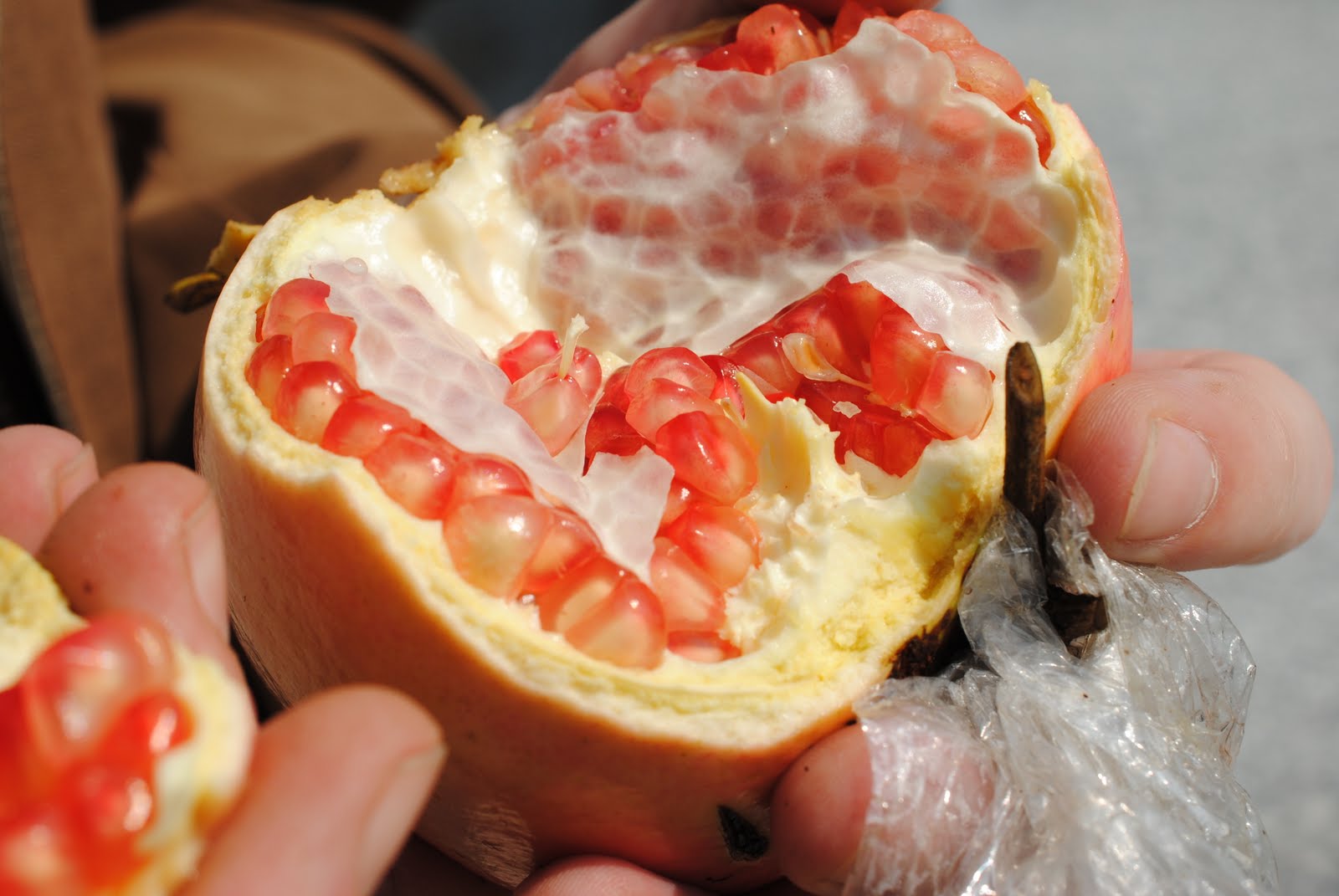 ng a pomegranate off an old woman. This was not in and of itself a mistake, but it signaled to the hundreds of other sellers crowding the tourist trap that we did in fact have money, and that we were in fact capable of some level of interaction with non-English speakers. (You should click on the picture of the pomegranate, if for no other reason than to share in my gleeful relationship with my new camera lens.)
Admission in to see the warriors is normally ¥110, but for reasons I'm still a little fuzzy on, anyone with a student ID could see them for ¥55 when we went. I would wager it had something to do with the holiday, much as I wagered they wouldn't be able to tell my driver's license wasn't from the University of Tennessee.
There are three major Pits which are open to the public. Pit 1 is the big one (in the picture at the start of this post, which, in full disclosure, is from Wikipedia.), while Pits 2 and 3 are both fairly unimpressive. Neither is lit well, and neither contains much. They are, forgive me, the pits.
The entrances and exits are labeled with "Way In" and "Way
 Out," which technically makes sense, but I got a strange sense of foreboding from them. It's funny how it's the little idiomatic mistakes that really get you. Walking in, I was stunned by how big the excavation is. "Imagine the size of the kiln," I thought. I took a lot of pictures in Pit 1. Looking at them after the fact, the weird combination of earth tones with speckled hints of blue and red makes it seem like the camera is broken. The on
 e to the left here is of particular interest to me because of the way the soldier in the center of the picture seems to be mugging for the camera. I'd bore you with more pictures, but you really have to be a member of my family for me to feel I can subject you to that.
I will say that one who visits the soldiers on a busy day should be as proud of every picture one manages as a war veteran is of every wound sustained in battle. The Chinese do not believe in the concept of "First come, first serve," and I had to fight to get every pole position.
In addition to the three pits, there is also a museum portion, though the largest section of the museum seems to be about the museum itself. What they
 housed in the museum before it had any history... I try to ignore the thought. Because it is a major attraction for China, the English signs throughout are well-translated, though it would likely have behooved the government to have a native speaker give them the once-over. Again, it's not wrong, but it's not quite right. As an aside to those who read the sign, China's self-centrist view, exemplified in the conception of "two civilizations" as China and Everyone Else, remains to me a fascinating thing.
After a walk through the heinously overpriced gift shop- keeping in mind that it was overpriced after the Westerners-only 50% off- Damian and I hopped on the bus back home.
* * * * *
I like to think, 37 years later, that the two farmers, having been relocated in the aftermath of the discovery, still don't understand why they had to move because a bunch of pottery was in their well.
Wednesday, October 5, 2011
I woke up this morning to the announcement that Steve Jobs succumbed to the pancreatic cancer he'd been fighting since 2005. Just last week, I was listening to an old episode of Desert Island Discs from 2003. Nick Hornsby was the guest. When he was asked what his luxury item would be, he said, "An iPod," and had to then explain to the host what an iPod is. In 2011, that seems ridiculous. In 8 years, the little mp3 player that could has gone from being barely known to being the standard bearer, even in many instances the generic term for all mp3 players.
The measure of a man is supposed to be his impact, and what he leaves behind. There is a sadness in this. But, more importantly, there is gratitude. Thank you, Mr. Jobs.
The measure of a man is supposed to be his impact, and what he leaves behind. There is a sadness in this. But, more importantly, there is gratitude. Thank you, Mr. Jobs.
The China Diaries: Happy Anniversary!
I've been in Xi'an for a month now. I arrived on the evening of 5 September, about an hour from now. It has, overall, been a wonderful month, with as many challenges as rewards, etc., etc.
In all seriousness, it has been a good month. I've been surprised in ways both good- The Chinese are just lovely people to foreigners- and bad- honestly, do you have to spit everywhere?. I have not had to work all that much, I'll come right out and say. I arrived just before a holiday that happened to fall on a day I wouldn't have had off from work, and I'm now at the end of a week off for National Day. The current Chinese Dynasty is 62 years old, if all the signs are to be believed (and, as this is China, they are, even if you don't, which you do).
I realize I have only been here a month, and I will not pretend to be any sort of expert, but I do have a few distilled nuggets of knowledge which are worth keeping in mind for the end of your first month:
1. It is always a good idea to have your dictionary and a note pad with you. The Chinese are not, by and large, good at the Point to a Few Words in the Dictionary Game, but if you write out a remedial sentence, they will happily oblige.
2. You will go through a period where all the food is wonderful, you eat everything, and both you and your digestive system are having a wonderful time. And then your digestive system will realize this is not a holiday, and it will take back all the nice things it said about the chow bing from the corner restaurant.
3. On a somewhat related note, tofu may taste lovely, but when it is frying... well, there are no words. Imagine that you've worn your shoes through a marathon, and then locked them in a humid box for a month. The smell you'd get when you opened that box isn't even close.
4. There are no lines. Lines were an abstract concept your parents made up so you wouldn't knock over the other children. You're an adult now. So are the other children. Have at it.
5. You will never need to learn how to say "please" in Chinese. "Thank you," "excuse me," and "you're welcome," yes, but never "please".
6. You will wonder how so advanced a civilization could have formed with so ridiculous a language. Honestly, with all the sounds the human mouth can make, why would you limit yourself to so few. Even a few clicks would help.
7. On the other hand, you will start to wonder why other civilizations didn't develop a logographic system of writing. It starts to make a remarkable amount of sense.
8. You will not get tired of funny translations: "Show the grass your mercy" on a "Keep off the grass" sign, for example. Or, for the more subtle among us, "Please keep the enterance clear" on an elevator sign. Makes a bit more sense than "entrance," really.
9. Your sense of what is or isn't a fair price for something will become wildly skewed. If I pay more than ¥10 ($1.50) for a meal, I ask questions.
10. People will say hello to you on the street. People will want to get their picture taken with you. You will think it is because you are a stunningly attractive human being, a perfect distillation of human evolution, and not bad to talk to either. You will be wrong. It is because you are white.
Keep all of these things in mind. It'll work to your advantage, I promise.
In all seriousness, it has been a good month. I've been surprised in ways both good- The Chinese are just lovely people to foreigners- and bad- honestly, do you have to spit everywhere?. I have not had to work all that much, I'll come right out and say. I arrived just before a holiday that happened to fall on a day I wouldn't have had off from work, and I'm now at the end of a week off for National Day. The current Chinese Dynasty is 62 years old, if all the signs are to be believed (and, as this is China, they are, even if you don't, which you do).
I realize I have only been here a month, and I will not pretend to be any sort of expert, but I do have a few distilled nuggets of knowledge which are worth keeping in mind for the end of your first month:
1. It is always a good idea to have your dictionary and a note pad with you. The Chinese are not, by and large, good at the Point to a Few Words in the Dictionary Game, but if you write out a remedial sentence, they will happily oblige.
2. You will go through a period where all the food is wonderful, you eat everything, and both you and your digestive system are having a wonderful time. And then your digestive system will realize this is not a holiday, and it will take back all the nice things it said about the chow bing from the corner restaurant.
3. On a somewhat related note, tofu may taste lovely, but when it is frying... well, there are no words. Imagine that you've worn your shoes through a marathon, and then locked them in a humid box for a month. The smell you'd get when you opened that box isn't even close.
4. There are no lines. Lines were an abstract concept your parents made up so you wouldn't knock over the other children. You're an adult now. So are the other children. Have at it.
5. You will never need to learn how to say "please" in Chinese. "Thank you," "excuse me," and "you're welcome," yes, but never "please".
6. You will wonder how so advanced a civilization could have formed with so ridiculous a language. Honestly, with all the sounds the human mouth can make, why would you limit yourself to so few. Even a few clicks would help.
7. On the other hand, you will start to wonder why other civilizations didn't develop a logographic system of writing. It starts to make a remarkable amount of sense.
8. You will not get tired of funny translations: "Show the grass your mercy" on a "Keep off the grass" sign, for example. Or, for the more subtle among us, "Please keep the enterance clear" on an elevator sign. Makes a bit more sense than "entrance," really.
9. Your sense of what is or isn't a fair price for something will become wildly skewed. If I pay more than ¥10 ($1.50) for a meal, I ask questions.
10. People will say hello to you on the street. People will want to get their picture taken with you. You will think it is because you are a stunningly attractive human being, a perfect distillation of human evolution, and not bad to talk to either. You will be wrong. It is because you are white.
Keep all of these things in mind. It'll work to your advantage, I promise.
Saturday, October 1, 2011
The China Diaries: Deal
On an adventure in the middle of Xi'an the other day, my companion wanted coffee. McDonalds and Starbucks are both options, even in Xi'an, but she wanted somewhere local. The Chinese are not known for drinking coffee, which made it a challenge, but I spotted a sign that said "coffee" as we were descending the steps to Starbucks.
I expected a coffee stand, or a small shop. When we walked in the door, I was stunned to find myself standing in a massive, mostly-marble lobby, leading to a grand staircase. "Well," I thought, "alright. I mean... why not, really."
At the top of the stairs was a very posh re
staurant. They gave us a menu for food and a menu for drinks (the menus literally said "Beautiful food" and "Beautiful drinks" on the spine). It was my least favorite sort of coffee shop, the sort where you can't order "a coffee." You have to order a specific type of coffee, be it the Blackwood Canyon Bean or the Beckett's Bitter Brew Bean, etc. I don't drink coffee, but I find the concept pretty obnoxious.
With the coffee taken care of, I called over the waiter and asked for the bill. Since I don't know how to say "bill" in Chinese just yet, I mimed opening and closing the sleeve a bill comes in by putting my palms together opening my hands.

This, as it turns out, is a fairly useful international mime for "bill," as those sleeves are in use everywhere. The waiter nodded in a comprehending manner, and went about his business. About two minutes later, a waitress came over with a serving tray and a deck of cards.
Now, there is surely some humor in the misunderstanding of the hand signal, but to me the real humor was that he understood my mime to mean playing cards, and that it was a logical conclusion in the context. We don't sell playing cards in American restaurants, even most of the nice ones.
Admittedly, the Chinese do seem to like their gambling much more than we do. But that's not all that surprising. It's illegal here.
I expected a coffee stand, or a small shop. When we walked in the door, I was stunned to find myself standing in a massive, mostly-marble lobby, leading to a grand staircase. "Well," I thought, "alright. I mean... why not, really."
At the top of the stairs was a very posh re
staurant. They gave us a menu for food and a menu for drinks (the menus literally said "Beautiful food" and "Beautiful drinks" on the spine). It was my least favorite sort of coffee shop, the sort where you can't order "a coffee." You have to order a specific type of coffee, be it the Blackwood Canyon Bean or the Beckett's Bitter Brew Bean, etc. I don't drink coffee, but I find the concept pretty obnoxious.
With the coffee taken care of, I called over the waiter and asked for the bill. Since I don't know how to say "bill" in Chinese just yet, I mimed opening and closing the sleeve a bill comes in by putting my palms together opening my hands.


This, as it turns out, is a fairly useful international mime for "bill," as those sleeves are in use everywhere. The waiter nodded in a comprehending manner, and went about his business. About two minutes later, a waitress came over with a serving tray and a deck of cards.
Now, there is surely some humor in the misunderstanding of the hand signal, but to me the real humor was that he understood my mime to mean playing cards, and that it was a logical conclusion in the context. We don't sell playing cards in American restaurants, even most of the nice ones.
Admittedly, the Chinese do seem to like their gambling much more than we do. But that's not all that surprising. It's illegal here.
Subscribe to:
Posts (Atom)
