The best cities have always looked beautiful from an airplane. Modern cities gleam in a way that's positively mesmerizing. Rio isn't aesthetically modern, but you're greeted by a uniquely delicate sprawl of lights, not as overwhelming as New York or Chicago, as far as the eye can see, coming up from the houses of the favelas and the residential neighborhoods. But on my first flight to China, last September, I noticed that towns, places still large enough to have a "center" without actually being cities, look like scars opening in the Earth. Cities have a preamble in their suburbs, a gradual build-up that results in a stunning climax of civilization. Small towns are surrounded by pastures and forests, and the juxtaposition of these sudden black gashes of human life against the verdant green of nature isn't flattering. Xi'an is, technically, a decent-sized city, yet I have a hard time believing it would look at all attractive from a plane. Provided, of course, that the sky was clear enough on any given day for you to actually see it. For what wonderful qualities it possesses, and I'll grant you I'm not sure there are many, Xi'an is not a beautiful place. In some ways I feel it is the place nature will one day come to die.
For a boy who grew up in the backwoods of Connecticut, the complete and utter lack of foliage is overwhelming at times. You have to go fairly far out of your way to reach life around here, and I usually don't have the energy. Last week, however, I had a good excuse to get out to the country-side, and so it was with no small amount of glee that I joined my roommate and a friend of his to 丰裕口 (fengyukou), a mountain about an hour outside the city. Xi'an is surrounded, on all sides, by massive, gorgeous mountains, but the smog here is so bad that not only can you not make out any details of the mountains from within Xi'an proper, you cannot even see them. Until a freak day where there was no smog last October, I had no idea there were mountains at all. I've seen them four times in a year.
We took a taxi for an hour, paying about 15 U.S. dollars for the privilege. Sometimes, exchange rates are amazing things. It was my first time to the mountains, and they really were lovely. A fellow classmate during my CELTA course ended up with a job in
Vietnam, and when I see his pictures, filled with the slightly-alien vegetation and mountainous terrain most of us think of when we imagine the Far East, I think "It must be nice to live
in Asia." Turns out
I've been living there the whole time. When we climbed out of the taxi, I turned to Mitchell and said, "My God, we're in China."
We strolled along the busy mountain road for ten minutes before coming to a spot that looked good. We hopped over the rail, under some barbed wire, and scaled down the side of the bank to the river. It was beautiful, isolated, quiet, and relaxing. Until about fifty minutes after we got there, when a Chinese man with a bullhorn started yelling at us, telling us we weren't supposed to be there. Apparently barbed wire means the same thing in Chinese as it does in English. He broke the spell of the mountain, and we started to head back down. All three of us were hungry, so we stopped in the first place we found that had refreshments.
Let me take a moment to describe, if I may, the place where we ate: I do not know what to call it. It had tables and a roof, but to call it a restaurant would have been charitable to say the least. The only food on hand was watermelon, which was agreeable enough. But what struck out, to me, was the bed. There are many businesses in China that function as the owner's home. You will often walk into a store and find a sleeping area in the back. But here, on the side of this secluded mountain, I caught a glimpse inside their open bedroom, and saw that this couple, both likely in their sixties, were sleeping on a board on four pillars of bricks. There was a single blanket on the board, and that was the whole of it. And these people had just sold us half a watermelon for what would buy you a Snickers bar in the U.S.
Mitchell and I sat down at the table and proceeded to eat as much of the watermelon as we could. We only wanted a quarter of a melon, but the two of us were made so uncomfortable by the poverty we were sitting in that we felt compelled to eat it all, to leave no bit wasted. Then we scurried away, our heads down, afraid to make eye contact with these people who have so much less than I've ever considered having, but probably aren't all that bothered by it. We grabbed a van back to Xi'an, returned to our flat, and sat there for an hour, not really moving or speaking.
It is a fact of life that you will be surrounded by people worse off and better off than you, unless you happen to be at the absolute extreme of either end of the spectrum. I, like most people reading this, was born towards the high end of the spectrum when it comes to living conditions. That I have a computer on which to write this, and that you have a computer and are able to read tells you that we are already ahead of 75% of the world's population, not counting then the rest of the material comforts. We are, truly, all privileged people for the way we've always lived our lives. And I'm not looking down on them. Both of them seemed perfectly content with life, sitting on the side of a mountain selling drinks and watermelon to travelers. This isn't about pity, this isn't about solving a problem. I'm not about to change my life violently. I'm not throwing away my earthly possessions, joining a monestary, and chanting for the rest of my life. I'm keeping on exactly as I have and will. But I will occasionally feel a little uneasy about it. For a few days, at any rate.
And I bet that mountain looks stunning from the air.
Wednesday, July 18, 2012

Tuesday, May 22, 2012
The China Diaries: Dingers! Dingers!
Last night, I was watching "The Simpsons" with some other teachers. It was the episode "Big Brother's Little Helper", and there were Chinese subtitles, as will happen sometimes.
The moment I want to share with you happened during this scene (You should watch it, this whole thing will make way more sense)
When Mark McGwire asks "Do you want to see me knock off a couple of dingers?", the crowd responds with a hearty "Dingers! Dingers!" The subtitles show them exclaiming "黑人!" That's Chinese for "Black people".
I will leave it to you to enjoy that. It's funny on a few levels. Particularly when you consider that McGwire just asked the crowd if they wanted to see him knock off a few. And they were very enthusiastic about it.
Saturday, April 14, 2012
The Teaching Diaries: Superstition
As a part of placing new students with the EF system, we do an interview. For our early teenage students, the test involves a list of questions where we are looking for specific implementation of grammar structures and vocabulary.
As the student successfully answers more questions, said questions get more difficult, and become freer in their construction. Often, students will provide entertaining answers. Once, I asked a student about dinosaurs, and he replied that "they lived a long time ago. They were big, and they ate plants... I don't think the plants ate the dinosaurs."
Just now, I presented the following to a student:
"Many people believe that if you break a mirror, you will have seven years' bad luck. What other superstitions do you know of?"
His response was priceless:
"I know in America, people pray to God and go to church on Sundays."
Brilliant. Absolutely brilliant.
Thursday, April 12, 2012
The China Diaries: You Are What You Eat
A few months back, I went to an animal market. Some of you will remember the posting; it was one of my most popular, full as it was with the pictures I seem to be making a point of depriving you of. I enjoyed seeing the market, but it was the beginning of my awareness of a massive incongruity between Western and Asian culture.
It isn't unheard of in the west for people who sell animals to be, if not necessarily cruel, then neglectful to the animals they sell. But it is not the rule. It is uncommon and frowned upon. If you were to walk into a pet store and see countless animals in cages too small for them to turn around in, you wouldn't take it all that well. You would, if you're anything like me, be taken over by an impulsive need to purchase all the animals and liberate them. Look at this parrot from that day at the market:

I wanted to buy him. I couldn't believe the vendor would let this bird get to such a point. It's not unhealthy, but it's not being taken care of. It deserves better. In the hour or two that I was in that market, I saw crates full of turtles, cages with hundreds of hamsters crammed together, stacks of cages with rabbits, cats, and dogs, and birds in cages where the droppings of both birds present and past were piled high enough to form hills.
As it turns out, this mentality doesn't stop with vendors. The Chinese as a whole do not seem to view pets in the same way that we do. For the West, pets are a part of the family. A dog is as well-cared for as your children, and in many cases, from a proportional viewpoint, it's likely getting a better deal than your kids. The same is true for birds, cats, even fish. One of the girls who bought a dog that day in the market carries it around in a bag. Not a purse, but an actual bag. Like the ones you get at the checkout in Wal-Mart. When she bought the dog an outfit that looked vaguely like Superman's, another coworker took to throwing the dog, "to see if it could fly." There is a girl who works at my school who has lost her last two dogs. Just plain lost them. She doesn't know where they went. On two separate occasions, she took a dog out for a walk, and when she got home, it was gone. That leash laws are nonexistent in China supports my theory that the dog got wise and ran away, figuring that a life fending for himself in the food markets like this fellow would be preferable to being treated as a toy. What's truly incredible about that is that, for the whole walk, she didn't notice.

I started, internally at least, to get on a bit of a soap box about the whole thing. Maybe not out loud, but I was certainly feeling superior. The Chinese have no sense of empathy with other living things. How foolish are they?, I asked the rhetorical audience in my mind. It came to a head the other night, when I saw a girl playing with her pet rabbit while I was ordering food.
She was four or five years old. It started when I saw her taking the rabbit out its cage. In the West, this is usually accomplished by tilting the cage so that the animal comes out, if not of its own volition, than at least with some sense of gentility. This girl reached in and pulled the rabbit out by its face. It was terrible to watch. I wanted to tell her she was hurting it, but I don't know how to say that in Chinese. Then she kept pestering it, picking it up by its ears or trying to force its mouth open so she could look. She even forced its nose down against the concrete and then would look at it. I'm not sure what, exactly, she was looking to have happen with that. Young children inherently have no empathy, but her parents, who were right there, weren't saying anything to her either. To them, there was nothing to say. I fought several urges, the most powerful of which, ironically, was to step on her fingers as I walked by or to grab her face and ask her "Do you like that? No? Neither does he."
As I quietly fumed about it, and talked to the other teachers who were there, as we'd all noticed, a few interesting points were raised. My roommate said that empathy for animals is a luxury for the wealthy, and while I do think that has a bit of merit to it, that's his explanation for everything in China. "Waiting in line for things is a luxury of wealth". "Clean air is a luxury of wealthy". I believe some of that, but the poorest farmer in the U.S. is going to take the best care he can of what animals he has, whatever is in his means. Even the ones that aren't directly related to how he earns his living. Then another teacher raised what seemed like a daft point at first, but has slowly grown to be, for me, the answer to the whole thing.
Consider, in America, that cruelty towards a dog is in most cases viewed as worse than cruelty towards a human; there's almost no chance that dog has done anything to warrant it, and certainly hasn't done so with the conscious knowledge that he was doing something reprehensible to begin with. It is, within society, thought to be as bad as cruelty to an infant. You simply can't get away with it. But then what about chickens? What about veal? What about lobsters? When you eat something, your attitude towards it will fundamentally change. We don't eat dogs, and so we can afford to feel this attachment towards them. We don't eat cats. We don't eat parrots. It goes on and on. There are, of course, many exceptions to this on an individual basis; Vegetarians who don't eat meat for moral reasons, people who don't eat veal or non-farm-raised beef, etc. That dog is consumed in China doesn't feel like an excuse for the incident of throwing the dog to see if its Superman cape works. That rabbit is consumed in China shouldn't excuse that girl playing with her rabbit in the same manner I once played with G.I. Joes. But it does, doesn't it? While none of us may like that chickens are kept in coops the same size as the chicken when confronted with the issue, and many of us buy products that tell us, rest assured, that no such chickens were treated in this manner, it still happens. And most of us are still okay with it. Because we eat them. And, while you can love what you eat, you can't eat what you love.
Saturday, April 7, 2012
The China Diaries: Abbott 和 Costello
In Chinese, "没有”, pronounced "may yo", means "Without," or "It isn't," or any such thing. It essentially means "I don't have it" or "It doesn't exist."
If you go to a Subway in Xi'an, most of the employees will speak at least a sandwich-aware version of English, wherein you can list ingredients and they'll know what's going on. When they get to the sauces, and they ask if you want any, and you say "Mayo", there's almost always a moment of hesitation when they try and decide if you mean "Mayo" or "没有”.
It's the little things in life that keep you smiling.
Thursday, April 5, 2012
The China Diaries: About Last Month...
As the rate of postings to the blog has dwindled to a measly post every month or so, I find myself faced with the reality of having become used, in at least some capacity, to China. It leaves me with a bit of a quandary. I want to post to The China Diaries more often, but I also want to continue to put my best effort to keep this from existing primarily as a diary. While I have certainly, on more than one occasion (this one included), indulged myself, I have for the most part tried to keep the focus on the culture, not on me, and I think I've done alright in that. Now, the urge to post more frequently regardless of the content is locked in a struggle with my editorial instincts, which say tis better to do infrequently and passionately than to do often and with disinterest.
I'm sure I'll somehow sort it out. In another three weeks, I'm going to Nanjing and Beijing for a week long vacation. That should provide some material, and certainly some pictures. In the next few weeks, I will be look into purchasing a small camera to use for day-to-day photos in a Picture of the Day feature, which I think could be rather a lot of fun. I apologize for the gaps in output. It is not my intent to be negligent. But I'm afraid most of what I could write about these days is not so different from what anyone else working a full-time job could write, whether they lived in China or not. That goes against what I try to do here, and so I am trying in some way to find a balance.
I'm sure I'll somehow sort it out. In another three weeks, I'm going to Nanjing and Beijing for a week long vacation. That should provide some material, and certainly some pictures. In the next few weeks, I will be look into purchasing a small camera to use for day-to-day photos in a Picture of the Day feature, which I think could be rather a lot of fun. I apologize for the gaps in output. It is not my intent to be negligent. But I'm afraid most of what I could write about these days is not so different from what anyone else working a full-time job could write, whether they lived in China or not. That goes against what I try to do here, and so I am trying in some way to find a balance.
Thursday, March 1, 2012
The China Diaries: To Market, To Market
Last week, I went to a market with some members of Chinese staff at my school. One of them was in the market for a bird or two. The others ended up impulse-buying dogs, which is not so unusual a thing to do in China. They don't seem to look at dogs as requiring the amount of care and responsibility we do in the West. Either way, I was there to document the events in pictures. This was the most crowded market I have ever been in, so many of these pictures aren't perfect. I could only fight the tide so often. As is always the case with Thoughts Dowinion, if you click on these photos you will be taken to a much larger picture.
 You can buy many, many things in a Chinese market. While part of this one specialized in pets, other sections sold things as varied as hardware, tea sets, and, in this case, random animal parts. They are used for medicinal purposes. Some highlights from this picture include the giant fungus, the goat or impala horns, and the bear paw.
 I don't know why these massive bowls were filled with egg, fish, some unidentifiable meat, and two spices, but I bet it smells amazing in the summer. I want to say they aren't for human consumption, but nothing in my experience of China would lead me to feel safe about that as an assumption.
 Countless cages and containers full of hamsters could be found. The cages, for the record, are not that small, but all the hamsters in all of the cages liked to huddle together in these tight masses. Of all the animals in a market where PETA wouldn't be able file injunctions fast enough, the hamsters were probably the best-cared for.
 Answering the life-long question "How do they get the turtles to the pet store." I took a few pictures before the owner of this store said "No no no no no."
 The original purpose of the trip was for Agatha to buy a bird. She wanted a bird that could talk, but they all proved to be outside her price range. Her first step down the ladder was this lovely little guy. The next few photos are of different birds in the market. The only one I can name is the Budgie in the middle two pictures. They're all nice to look at, named or otherwise.


 This little guy was in the running for purchase as well. Agatha spent about a minute trying to get him to talk before it was pointed out to her that he's not a parrot. This was of great disappointment, and so he was passed over. I liked him, though. He had character.
 She settled on a pair o' keets. Here we witness the sexing of the birds. She wanted a boy and a girl so that they would reproduce one day. In the name of continuing the species, the birds had to undergo this humiliation. Perhaps the shared experience will have bonded them.
 Here's the happy couple, already seemingly unaware of the embarrassment they've endured. Love heals all, apparently.
 The birds were in one section of the market, the fish in another, and the cats and dogs in yet a third. Above, a man stares deep into the eyes of a puppy while holding his cigarette. The Chinese for the most part view dogs as accessories, I think. Not necessarily in the Paris Hilton sense of accessories, but they aren't viewed as a part of the family like they are in the states. For example:
 When Jessica bought her dog, they gave it to her in a plastic bag, much as the checkout clerk at The Home Depot would give you your bundle of wire and new hammer in a plastic bag. She still carries it around in that bag, ten days later. Below, you can see him sans bag.
 I am sorry for the lack of pictures of the market as a whole to give you a better idea of the area itself. I'll keep that in mind for future write-ups.
 You can buy many, many things in a Chinese market. While part of this one specialized in pets, other sections sold things as varied as hardware, tea sets, and, in this case, random animal parts. They are used for medicinal purposes. Some highlights from this picture include the giant fungus, the goat or impala horns, and the bear paw.
 I don't know why these massive bowls were filled with egg, fish, some unidentifiable meat, and two spices, but I bet it smells amazing in the summer. I want to say they aren't for human consumption, but nothing in my experience of China would lead me to feel safe about that as an assumption.
 Countless cages and containers full of hamsters could be found. The cages, for the record, are not that small, but all the hamsters in all of the cages liked to huddle together in these tight masses. Of all the animals in a market where PETA wouldn't be able file injunctions fast enough, the hamsters were probably the best-cared for.
 Answering the life-long question "How do they get the turtles to the pet store." I took a few pictures before the owner of this store said "No no no no no."
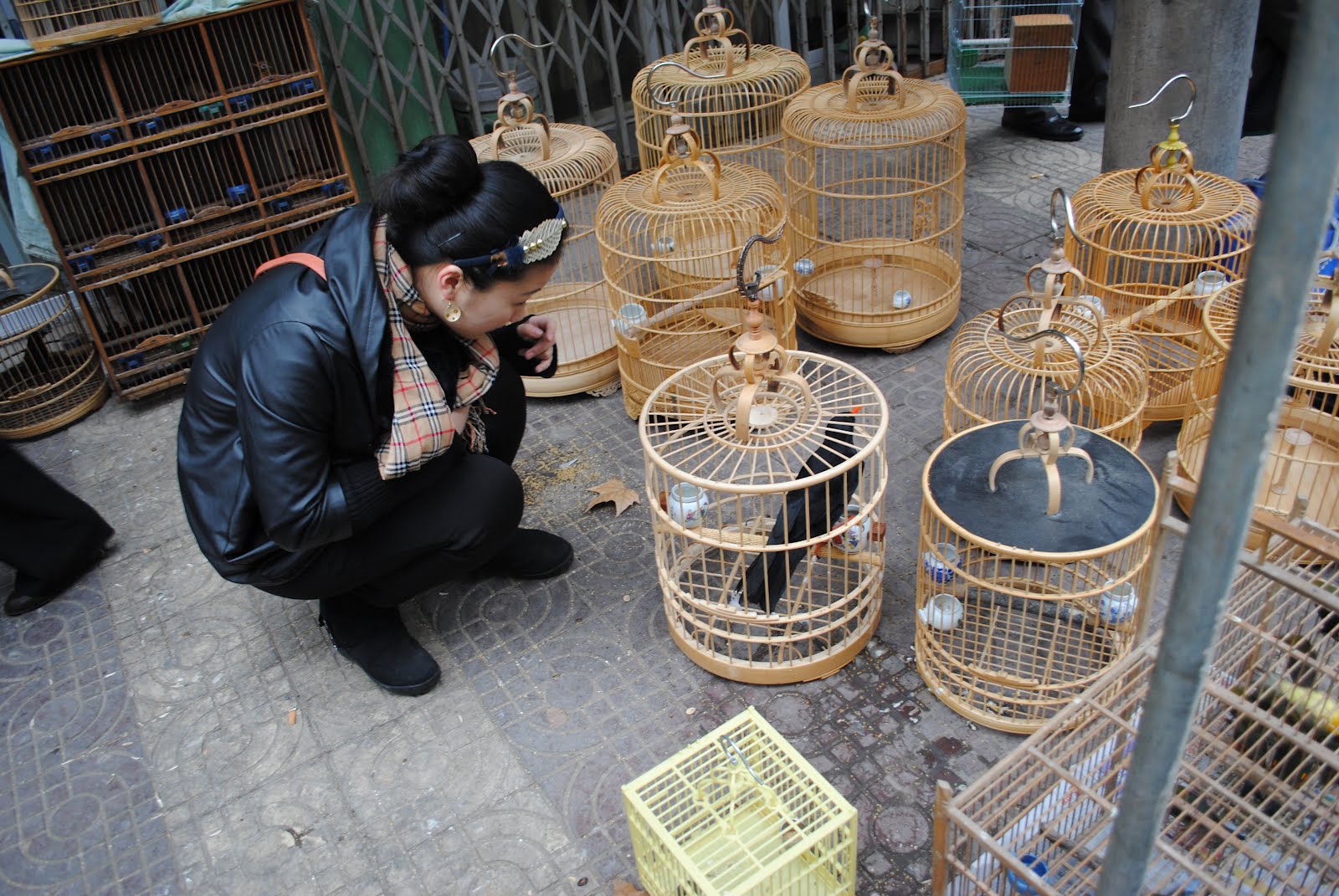 The original purpose of the trip was for Agatha to buy a bird. She wanted a bird that could talk, but they all proved to be outside her price range. Her first step down the ladder was this lovely little guy. The next few photos are of different birds in the market. The only one I can name is the Budgie in the middle two pictures. They're all nice to look at, named or otherwise.


 This little guy was in the running for purchase as well. Agatha spent about a minute trying to get him to talk before it was pointed out to her that he's not a parrot. This was of great disappointment, and so he was passed over. I liked him, though. He had character.
 She settled on a pair o' keets. Here we witness the sexing of the birds. She wanted a boy and a girl so that they would reproduce one day. In the name of continuing the species, the birds had to undergo this humiliation. Perhaps the shared experience will have bonded them.
 Here's the happy couple, already seemingly unaware of the embarrassment they've endured. Love heals all, apparently.
 The birds were in one section of the market, the fish in another, and the cats and dogs in yet a third. Above, a man stares deep into the eyes of a puppy while holding his cigarette. The Chinese for the most part view dogs as accessories, I think. Not necessarily in the Paris Hilton sense of accessories, but they aren't viewed as a part of the family like they are in the states. For example:
 When Jessica bought her dog, they gave it to her in a plastic bag, much as the checkout clerk at The Home Depot would give you your bundle of wire and new hammer in a plastic bag. She still carries it around in that bag, ten days later. Below, you can see him sans bag.
 I am sorry for the lack of pictures of the market as a whole to give you a better idea of the area itself. I'll keep that in mind for future write-ups.
Subscribe to:
Posts (Atom)
