Showing posts with label Classic. Show all posts

Thursday, September 17, 2009

Paul Simon

Paul Simon
(1972)

Paul Simon, the eponymous solo debut by Simon & Garfunkel mastermind Paul Simon (I say all this like you don't know who he is... *shakes head*), is the only album I can credit with having saved my life. In December and January of this past winter, Paul Simon preserved my sanity. I'll spare you the details and simply note that I was in a bad place. I was in a very, very bad relationship, and I was alone in Chicago for five weeks. There were three-or-four day stretches when I would not see even the hall outside my apartment door. These were not high times. I wrote an unprecedented amount of material in those five weeks; between the solitude and the ever-shifting emotional space I occupied, it was a prolific period, certainly. I threw myself as fully into my work as I ever have, and that was very rewarding, but the writing I did in that period was intensely personal, and required me to stare straight in the face of the very things which were tearing me apart inside. The only thing that brought me back at the end of each day, and every day ended with me frustrated, exhausted, and unable to stop thinking, was listening to Paul Simon as I fell asleep, night after night.

I often listened to it during the day, as well. I listened to it three or four times a day, on occasion, though I usually did my best to restrict the habit to once a night, when it was a balm, a salve to my sanity. During the day, it simply kept me from falling apart entirely. Any time I felt myself losing what composure I had, I put it on, and it would stop the bleeding, if only for a few hours. But, at night, laying in bed, with nothing to focus on but breathing and the music, it took on a healing power I've never found in any other music. Everything was alright, everything would work out, and I was going to survive this.

To be fair, I'd never been in as intense a situation as I was at that time, and, if Paul Simon hadn't been there, I'm sure I would have found something else. But it was there, and it was all I needed. I didn't have much else in the way of input during that time; television, movies, and all other music allowed my mind to wander, and I found it hard to focus. Books weren't even close to an option. I couldn't focus for a sentence. When I wasn't writing, I was probably listening to Paul Simon.

Not surprisingly, once that period was over, I didn't listen to it much. It wasn't a conscious choice, but there's no sense in arguing that I wouldn't have found the emotions attached to it overwhelming and unpleasant. It became a sort of talisman, a box in which I poured everything negative from that time, and I left it on the shelf, afraid to touch it, to disturb what was inside. I remembered the important role it played, but the music was lost in the shuffle. So to speak.

A little over a week ago, due to circumstances in my life which have brought the tail end of that chapter to a close, I listened to Paul Simon for the first time in eight months. Every note of it was still familiar to me, I could sing every word; it was almost as if the album had never left, but, this time, it wasn't serving a function. It was there to be enjoyed, not to be relied on. And I discovered, rediscovered, how truly amazing a piece of work it really is.

On a technical level, I'm only now really appreciating all there is to appreciate about it. It was a blanket before. Now it's a tapestry. There is a remarkable, subtle variety to the songs here; it was meant to be appreciated as a whole, and that shows, as the songs are all dissimilar yet still familiar with one another. Paul Simon's voice is calming, weary, withdrawn even; he wrote the album in the aftermath of a divorce, and the sadness, hurt, resolve, and real, true pain are all found throughout these songs, without ever being reduced to a cliche. He manages to dissect the pains of dissolved love with a combination of empathy and intelligence which many strive for, but almost none achieve.

I bought the LP today, as I've only ever heard it as mp3s. The fullness of the sound, and the details I could hear, as this thing which was so familiar and important to me took on a whole new beauty and quality, a whole new existence, almost brought me to tears. I can't recommend it enough.

Tuesday, September 1, 2009

Me and Them Lonesome Blues

Blue
(1971)
Joni Mitchell

This is not, you may have noticed, a review of a new album. I have decided to eliminate a regular Classics-themed article, and instead will simply write up Classics when I am driven to do so. This should, I believe, ensure that the write-ups are impassioned, and I am writing them simply out of a deeply felt want to spread the wealth, as it were.

My roommates and I recently visited Reckless Records, a well-known record store here in Chicago. I tend to stay away from record stores most of the time; no matter how cautious I am upon entry, I am bound to leave no less than fifty dollars lighter. These are purchases I enjoy making, of course, but it's not something I want to make a habit of. I've been trying to keep my vinyl-related impulses in check since I went a bit eBay-happy two years ago. At any rate, it has been quite a while since I bought a record, and I felt it time for a hit.

I walked away with some Elvis Costello LPs, a pair of Elvis Costello singles, the single for "Flashdance... What a Feeling" from Flashdance (what a chorus, huh?), and two Joni Mitchell albums. Joni Mitchell is someone I resisted for a long time. When her most recent album, Shine, came out in 2007, the multitude of articles I read about her left me with a bad taste in my mouth; her persona seemed very self-righteous, to a degree that I felt made it unlikely it wouldn't leak its way into her music. Not self-righteous like, say, Elvis Costello is self-righteous; that's more an issue of too much confidence. I'm talking about the kind of self-righteous that found its way into folk music in the sixties. If you don't know what I'm talking about, there's a song on the Elektra Records compilation, Forever Changing, that is EXACTLY what I reference. I can't remember what it's called, but the entire compilation's only eight or nine hours long, so you should just listen to the whole thing and you'll come across it.

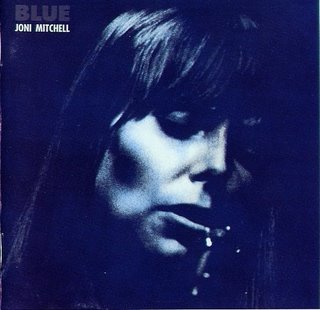
Last June, I was compelled to listen to Mitchell for the first time. I started with the one you hear the most about, provided you run in circles where you hear about Joni Mitchell; Blue. I was surprised, immediately, by the energy present. Here is an album whose cover does not exactly scream up-beat, yet the opener, "All I Want," overflows with enthusiasm, with a certain amount of humour. It sounds like Joni Mitchell had a good time recording that song, which is probably the best kind of energy any record could ever hope to get across. If the band sound like they're having fun, then the audience probably will, too.

The songs contained here are remarkable on a number of levels; for one, the lyrics reward inspection. Joni Mitchell is held up as a peer of Leonard Cohen, as apparently there is something about Canada that fosters introspective, poetic rambling, but I find her lyrics to be more involving. Laughin' Lenny slips into trite metaphors a bit too often for my comfort. Mitchell's lyrics here are never less than exemplary.

Another great feature is the recording itself; this album was done by experts, and everything sounds so lush. It's an album that functions both as active, involved listening, and would be great to throw on in the background of, say, a dinner, if you're one of those types of people (I'm not, but I'd be willing to try). In my experience, only Randy Newman's Sail Away has more clearly illustrated the difference between an mp3 and a vinyl record.

Mitchell's voice is the third draw; it can, and does, do everything. Her range is spectacular, and her power of expression belies all explanation. You can feel the catharsis, but, and this is key, unlike so many albums since, you're never overwhelmed by it. While it is often personal, and never shies away from expressing an emotion, at no point does Blue come across as an album Mitchell wrote for herself. That is unquestionably one of its greatest strengths.

The guitars give way to piano as the album moves on, and the results are even more engaging. My favourite cut is "River;" Joni Mitchell incorporates part of "Jingle Bells" into the piano interludes, giving it a spectacularly sparse, wintry feel. It's the most immediately atmospheric, the song most capable of dominating a space with its mood. It's also achingly beautiful, and a perfect example of what this album holds in store. Absolutely essential.

Grade: A+