Monday, December 16, 2013

Accidental Racism


Brad Paisley, the Irony of “Accidental Racist”, and the Danger of Thinking Outside Your Station.

I have enjoyed Brad Paisley’s music for a long time. My parents discovered country music when I was in middle school, so I was often exposed to it in the car, and his songs stuck out because of their genuine humor, their wit, and his guitar playing. He didn’t write anything that left the country wheelhouse, but he went about it with more creativity than most. My appreciation of his work increased with my interest in music, and codified when he released American Saturday Night in 2009. That was the album that launched him from successful country musician to a superstar, and deservedly so. Within the realm of popular music, it’s kind of a masterpiece.
Several different aspects of Paisley’s music, which had been hinted at here and there on previous albums, bloomed with American Saturday Night. His guitar playing was out in full, astonishing force, the songs were varied in subject and style, and he wasn’t limiting himself to the acceptable norms of a popular country artist at the time. From the standpoint of ethos, the most important song on the album was the title track, a song about multiculturalism that disguised itself as being about a night out on the town. Songs about multiculturalism, be they positive or negative, are not anything new. Gogol Bordello have been mining that vein for a long time. Doing it in the context of a mainstream country song, though, that was something else.
It’s genuinely not fair to say that all people who listen to country music are close-minded Republicans who think that the border with Mexico should look like a highway sound barrier with barbed wire on top. It’s really not. The fan base for country music is far too large, and far too diverse for that to be anything resembling a fair statement. However, there is a certain truth to the idea that country, on the whole, has a more conservative audience, and up until recently, its music and artists played to that. Within the last five years, and particularly this year, there has been a slow but steady shift in the ideology presented by mainstream country music, and a lot of that shift can be traced back to the song “American Saturday Night”. While the music itself never espoused ideas along the lines of “build a wall” or “they took our jobs!”, the music was always well ensconced in a world where those values were defacto. You had the odd “Courtesy of the Red, White & Blue”[1], or “I’m Proud to Be an American”, but on the whole the ideals were accepted through ignorance of the alternatives. Now songs like Miranda Lambert’s “All Kinds of Kinds”, which makes explicit reference to the acceptance, even necessity, of cross-dressers, gay people, and immigrants, are not only entering the country charts, but dominating them[2].
American Saturday Night did not cause a massive, overnight shift in country music, and it seems Paisley felt this, because his next album, This Is Country Music, while still showcasing his craft, humor, and personality, seemed to be a retreat back into the inner sanctum. The title track is a song expounding the virtues of traditional country music, and what it does for people. “Old Alabama” is about driving with a girlfriend and listening to Alabama, the epitome of traditional popular country. The album had the same astonishing musicality, but it wasn’t trying to expand. It was comfortable sitting in the envelope, instead of pushing against the edges. There’s nothing inherently wrong with that, but after the promise of American Saturday Night, it was a let-down.
Based on the evidence of this year’s Wheelhouse, Paisley also found it unfulfilling. This is an incredibly ambitious album. While my opinions about its ultimate quality are mixed, it’s impossible to listen to it without being impressed by what he’s tried to do. In the end, your opinion may depend on how much you value the concept of a work over the execution. Musically, it reaches from Kinksian pop to stadium rock. There’s a guitar instrumental inspired, at least in part, by Ennio Morricone. “Southern Comfort Zone” welds the aforementioned stadium rock with a church choir.  The main hook to “Beat This Summer” has more than a little hip-hop to it. And, most importantly, Brad Paisley the progressive lyricist has come back. With a vengeance.
At times, Paisley’s considerable abilities are perfectly matched with his ideological ambitions. “Southern Comfort Zone” is “American Saturday Night”’s older, worldlier brother, a song about needing to travel the world and experience the unfamiliar. It is so cunningly disguised as a stock Southern Nostalgia song that I read a review faulting it for being an unremarkable one. “Karate” deals with domestic violence, in the form of funny, light revenge porn. Other times, however, his ambitions, be they musical or thematic, get a bit ahead of his pen, and, this time, he received a lot of flack for it.
“Accidental Racist” is Paisley’s attempt to deal with unintentional racism, or passive racism. It’s certainly a legitimate subject for a song, and it’s even a brave one, for country music or otherwise. How many mainstream artists can you think of who have written songs that deal directly with the idea of racism, and are not from the perspective of someone who’s a victim of it? I can’t think of any off the top of my head. It’s an issue fraught with complications, presuppositions, sensitivities, and god knows what else. Paisley was, if not openly criticized for the idea behind the song, at least derided for the quality of the execution, which, to be fair, is pretty terrible. The music is bland, the rapping section is well-intentioned but trite, and the lyrics are very poorly thought through. They are, themselves, racist. The man who walks into the Starbucks, with his cowboy hat and Lynyrd Skynyrd t-shirt, is a caricature of the white south, and the black man behind the counter, with his pants sitting low, his doo rag, and his gold chains, is a caricature of inner city black people[3].
The lyrics make any number of mistakes outside of the cursory treatment of the individuals involved. This has all been covered before, by other people, and I don’t wish to spend much time on it, but lines like “If you forgive the gold chains,/ then I’ll forgive the iron chains” are so fundamentally misguided in their conception that it’s easy to dismiss the song in its entirety. I’m also not advocating its existence as a listening experience, but I do think Mr. Paisley deserves a substantial amount of credit for attempting to start what is a very difficult conversation, even while unintentionally fueling the very fire he is attempting to discuss.
It’s easy to dismiss Paisley as just another privileged white male, who doesn’t really understand what he’s talking about, but I would argue that the best reason to discuss something is because you don’t understand it and you want to. He also deserves more credit, yes, more, for joining that conversation as a wealthy white male living in the United States, and for doing it from his own perspective. We have a problem in this country where we immediately dismiss anyone who’s not on the disadvantaged end of an argument. I’m a white male, and often feel that others believe I couldn’t possibly have anything productive to say about racism, or sexism. If you are at all aware of the world around you, it is incredibly difficult to say to someone, “God, I’m sorry, I really never realized that the flag on this shirt would offend you.” That requires admitting you were, if not wrong, then at least oblivious, requires admitting that you have hurt somebody else, and requires you to reevaluate things about yourself! That’s huge! And, again, Brad Paisley deserves a lot of credit for even thinking about going out on that limb in the first place. That he did a poor job and fell is very unfortunate. That song could have been important if it had been done well. Its botched execution shouldn’t take away from the fact that the man is trying to have a difficult discussion a lot of people need to have, but aren’t. And the response to the song will only continue to prevent people from trying again in the future.


[1] Really a phenomenal piece of work if you ignore the wider implications of the lyric.
[2] Two interesting conversations, about whether or not the country audience was ever actually as close-minded as it was perceived to be, or if it was a mob mentality, and about the current, concurrent prevalence of songs about hanging out and drinking with the boys, which could be argued as an answer to the progressive songs, are for a different time.
[3] As well as being in clear violation of Starbuck’s dress policy.

Monday, October 29, 2012

Madness

I wonder what it's like to be in Muse. The success is undoubtedly thrilling; healthy album sales in an era where 200,000 copies in the first week can get you to number one, regularly playing to massive crowds in massive stadiums with an accordingly massive concert fee, the kind of loyal fanbase who only ever seems to materialize to support prog- and metal-tinged acts, the creative freedom to chase whatever half-crazed idea you want not only down the rabbit hole but back out through the other side; These must all be great things to experience first-hand.

Muse have made bombast a trademark, possibly more than any band before. Queen, the band most frequently sited as Muse's forefathers (this is a lazy comparison; Muse add Queen-like flourishes to their songs, but they are fundamentally very different bands), were known for being ridiculous, but seldom were they bombastic. Look at "Bohemian Rhapsody"; it is over-the-top, yes, but it does not seek to over-power you. It is clever. It wants you to come along willingly. Compare that to any cut on any Muse album since Absolution, not including the slow ones, and the differences in approach become readily apparent. All three members of this very-much-a-Power trio reach out of the speakers and beat you over the head with their instruments, taking you with them whether you like it or not.

This, oddly enough, is central to their appeal.

And that appeal should be well-served by their new album, The 2nd Law. It is certainly big. The opening track, "Supremacy", is so overblown that I briefly found myself wondering if Muse had actually developed a sense of humor (another key trait that differentiates them from Queen, who always knew well enough to giggle along with the rest of the world). Once again, they have delivered an album of massive sing-along stadium anthems, this time with some dance music thrown in. But there is a problem with this album, much as there was with The Resistance, and I think it signals a change that deserves to be examined.

With Origins of Symmetry, on the whole a pretty poor album, Muse at least started to create their own sound. Absolution was that sound brought to full-throated life. The arrangements were almost always left to bass, guitar, and drums, but they made a hell of a lot of noise for just three guys. Black Holes & Revelations sought to flesh that sound out. They added mariachi horns, more strings, more pianos, more hooks. And there was an intangible, ineffable sense of it being bigger. "Knights of Cydonia" summed up the new direction Muse would be taking better than any other track on the album. And part of me thinks they know that's what happened, because since then, it hasn't quite been the same.

Before, when you listened to a Muse album, there was a palpable sense of ambition. They were striving for something. Whether you liked them or not, you had to concede at least that much. But in the subsequent albums, The Resistance and The 2nd Law, ambition has been replaced with scale. These are not the same thing, and should not be confused, though they often are. While The 2nd Law incorporates elements of dance music the band have only flirted with once before, they have not gone as all-out in their attempts to wrestle with the genre as they did with "Supermassive Black Hole". The attempt seems perfunctory, more commercially driven than artistically inspired.

There has been a bright spot in each release. The Resistance had the Exogenesis Cycle. The 2nd Law has "Supremacy", "Survival", and "Madness". "Supremacy" and "Survival" manage to encapsulate both scale and ambition, which is what Muse, until now, have done best. "Survival" is perhaps the most ridiculous, overblown, and silly song they've ever recorded. By definition, that makes it the most successful as well. But "Madness" is the key track here. The slow tracks on Muse albums have traditionally been the weakest, having neither enough musical beauty nor anything resembling lyrical coherence to maintain them, but here they've finally done something quietly stunning. Chaining the sounds of dubstep to an r&b slow jam in disguise, they've created the first truly moving song in their canon. It boarders on subtle, which, by Muse's standards, is astonishing. The most impressive thing is that they pull it off.

With The 2nd Law, Muse have mostly cemented a transition from exciting to reliable. The majority of the songs here are entertaining while you listen, only to fade as soon as they're over. But there is a glimmer of hope in "Madness". Muse would have to change how they seem to be defining themselves to embrace the new directions it proposes. The question they have to ask themselves, taking into consideration their album sales, concert audiences, and staunch fanbase, is whether or not they'd be mad to.

Thursday, September 20, 2012

Gee, but It's Great to Be Back Home

It was announced this week that Chick-Fil-A will no longer donate money to groups that oppose same-sex marriage, a decision that in all likelihood grew out of a desire to expand into the lucrative Chicago market. I don't eat much in the way of fast food, and I don't live in the United States anymore, so this part is of no real interest to me.

What I find fascinating is the reaction of those who so vehemently supported Chick-Fil-A on Customer Appreciation Day, back when it first came to light that Chick-Fil-A was against gay marriage. A quick look at the Chick-Fil-A page on Facebook shows a lengthy trail of comments from people who are hurt, betrayed, and angered. "Goodbye, Chick-Fil-A," they say. "We thought you had principles."

Now, having principles is all well and good, but let's be realistic about this; when the CEO of Chick-Fil-A announced on radio that Chick-Fil-A supported traditional marriages and opposed non-traditional marriages, can anyone honestly tell me he wasn't going fishing? The amount of free publicity Chick-Fil-A got out of that one radio interview was easily two or three times their annual marketing budget. Customer Appreciation Day was the reward. Yes, all these hundreds of thousands of people were standing up as one, eating at Chick-Fil-A, and saying, with one voice, "We support your beliefs." For those people, the most important part of that sentence might be the bit about supporting beliefs, but for the CEO of Chick-Fil-A, the most important part is "eating at Chick-Fil-A." And, frankly, it should be

Chick-Fil-A reaped the benefits of its practices in a glorious, month-long frenzy of activity. And now, because no one's business ever closed because they stopped supporting something, they are doing the sensible thing, dropping their association with traditional marriage, and opening up branches in Chicago. And if a few of their southern branches do close? Rest assured that the profits from a Chicagoland Chick-Fil-A will far outstrip the lost earnings of a restaurant in rural Tennessee.

To the people who supported Chick-Fil-A on Customer Appreciation Day, who find themselves so hurt and betrayed now: Can you honestly tell me that before this became a national fad, you had any idea about what Chick-Fil-A did with its money? And can you honestly tell me you ate there because the company had the same values as you? No. You can't.

There's a good chance that Customer Appreciation Day was, and will remain, the only time any of you have actually done something to express your support of traditional marriage, and to voice your opposition to gay marriage. Which is fine. When I go to zoos, I put a quarter in the spinning drum to save the rainforest. We, as a people, like a convenient way to express our support. That's why the "Like" button is so successful as a cultural meme. One click lets me express my support in as generic and unthinking a way as possible. Just like ordering the #1 combo with slaw and a coke zero.

Many of you are complaining on Facebook, a company which has been very consistent in its support of Gay rights and equality. But that hasn't made the news yet. So I suppose, until it does, you can carry on with your new-found feelings of superiority towards Chick-Fil-A. You were in this together, you and those cows on the billboards, you and every person who works at a Chick-Fil-A. And now they all turned their backs on you. How dare they stop believing in something they originally believed in for the sake of a dollar just for the sake of a dollar?

The nerve of some people. Honestly.

Monday, September 3, 2012

The China Diaries: Who's Your Caterer?

Coming home from work one night, my roommate and I noticed a tent being set up on the sidewalk opposite our house. This, in and of itself, was not unusual. The Chinese approach to zoning laws and permits is noticeably lax in comparison with any Western country, and I get the impression you can put whatever you want up wherever and whenever you'd like.

The next morning, I could hear celebratory music coming up from around the tent. Mitchell and I looked out, and it was full of people. I've lived in China for a year, and, despite having bought a camera explicitly for the purposes of taking pictures in China, I haven't taken all that many. I don't find that much to photograph in Xi'an, which is equal parts failing on my part and on the part of the city. This seemed to provide the perfect opportunity to take some. I threw on an undershirt and some shorts, popped on my flip-flops, and went with Mitchell to look around.

It looked like a wonderful party. There were around 35 people sitting at tables, eating some lovely food (Photos of said food can be found at the bottom of the post). Everyone was chatting and having a good time. Being so obviously foreign in a country is a double-edged sword. On the one hand, you have the occasional xenophobe, but on the other, much more full hand, you do get granted a sort of celebrity status. We often get stares when we go places, and we're always offered drinks by Chinese people, held in sway by our pale brilliance.

And this was *before* we got close enough to be in their way.
It gives you liberties, is the thing. We walked into a celebration we didn't know anything about, were allowed to walk around taking pictures of the people and their food, and generally be in the way, without raising much more than an "Oh, those crazy foreigners, at it again." And since this festival looked pretty open, we decided to order some food. There was a dish with green peppers and chicken that looked particularly good. To the left, you can see it in mid-wok.

They didn't blink an eye, and within a few moments they had scrounged up three stools for us to use, one as a table and two for the typical use, and served us. The good was delicious. They tried to give us beer, but it was a work day, so we bought some sodas from the convenience store.

About two minutes after we started eating, a young man came up to us and asked, in English, if there was anything he could help us with. We smiled and said that everything was wonderful, but he didn't walk away. After a few seconds, he said, "You are eating our lunch."


"Oh, is this your lunch?"

"Um, yes," he said. "This is my grandfather's funeral."

Well, then. This all seems... chipper.

We apologized, telling him we had no idea it was a funeral. "We heard this wonderful, happy music and saw all these people, and decided to come check it out. Then all the food looked so good and everyone was having such a good time, and when we ordered they didn't act like it was a problem or anything." It's very difficult, trying to apologize profusely while simultaneously continuing to eat the food. I addressed this by letting Mitchell do the apologising while I did the eating.

It's hard to say if he was offended, ultimately. He told us about some aspects of Chinese culture, that funerals in China are a happy affair when the person has lived a long life, and he told us about the black band he was wearing. To be fair to us, most of the people weren't wearing black bands; I would have noticed that and worked out that we were funeral crashing. I did an excellent job, while he talked about the band, of not saying "Oh! Yes! That's how the Pandas got their black spots! I learned about that in grade school!" I was proud of my discretion.


I compared the crowd of people at this celebration to the people at my own grandfather's funeral. The West is known for having a particularly dour relationship with death. We don't go into mourning for forty days, or anything so extreme as that, but we certainly do tend to focus on the negative aspects. Instead of celebrating what has been achieved, we tend to be sad just to be sad. And that's normal enough. It's even healthy. I love a good cry as much as the next girl. But I think the Chinese might be on to something here. I may not ask that my funeral be held in a tent, but, God damnit, there's going to be some good food.


Wednesday, August 22, 2012

Os Diários de China: Ah. Entendi. Me Desculpe.

To my English-language readers: This story will be posted tomorrow in English, but as I went through the trouble of writing it up in Portuguese for practice, and I do have some readers from Brazil, I wanted to post it here.

Ontem, eu e meu companheiro do quarto vimos uma tenda fora de nosso prédio. Na tenda, já com muitas pessoas, e nós ouvimos uma musica muita animada. Ey morei na China por um ano, mas eu não tirei muitas fotos. Minha maquina é muito cara, boa, então não a levo em todos lugares. A ironia é que eu comprei a maquina para tirar fotos na China...

De qualquer maneira, como não tenho muitas fotos da minha vida na China, e como a tenda parecia novela, eu decidi ir à tenda. As pessoas eram alegres, e todos comiam bem! Os peixes, frangos, e legumes de todos os tipos, não consigo nomear todos. Nós pensamos, isso é uma festa!

Meu companheiro perguntou a um chef, "Nós podemos comer? Queremos comer frango com as pimentas." O chef nos deu dois bancos, uma bandeija, e dois pares de pauzinhos. Sentamos e comemos.

Após cinco minutos, um homem da tenda falou para nós em inglês; "Eu posso te-ajudar?" Ficamos confusos. Eu respndi, "Não, tudo bem!"

Ele não deixou. "Vocês estão comendo o nósso almoço."

"Perdão?"

"Isso é o funeral do meu avô."

...

Ah.

E agora? Nós continuamos comer? Pedimos desculpas? Não sei. A boa notícia? O homem estudou no meu estado, e ele falava inglês muito bem. Eu não acho que ele ficou ofendido. Bem, espero eu que ele tenha ficado. Alguns homems nos deu doses do "Baijiu", um alcoól muito forte (Que? A beber é educado...), e nós voltamos para casa. A comida estava muito, muito deliciosa, e todos, assim como eu disse, estavam felizes. Quando minha familia têm meu funeral, eu quero que seja igual.

E, sim, agora, eu tenho algumas fotos muito boas. Eu vou postá-los amanhã.

Wednesday, July 18, 2012

The China Diaries: #firstworldproblems

The best cities have always looked beautiful from an airplane. Modern cities gleam in a way that's positively mesmerizing. Rio isn't aesthetically modern, but you're greeted by a uniquely delicate sprawl of lights, not as overwhelming as New York or Chicago, as far as the eye can see, coming up from the houses of the favelas and the residential neighborhoods. But on my first flight to China, last September, I noticed that towns, places still large enough to have a "center" without actually being cities, look like scars opening in the Earth. Cities have a preamble in their suburbs, a gradual build-up that results in a stunning climax of civilization. Small towns are surrounded by pastures and forests, and the juxtaposition of these sudden black gashes of human life against the verdant green of nature isn't flattering. Xi'an is, technically, a decent-sized city, yet I have a hard time believing it would look at all attractive from a plane. Provided, of course, that the sky was clear enough on any given day for you to actually see it. For what wonderful qualities it possesses, and I'll grant you I'm not sure there are many, Xi'an is not a beautiful place. In some ways I feel it is the place nature will one day come to die.

For a boy who grew up in the backwoods of Connecticut, the complete and utter lack of foliage is overwhelming at times. You have to go fairly far out of your way to reach life around here, and I usually don't have the energy. Last week, however, I had a good excuse to get out to the country-side, and so it was with no small amount of glee that I joined my roommate and a friend of his to 丰裕口 (fengyukou), a mountain about an hour outside the city. Xi'an is surrounded, on all sides, by massive, gorgeous mountains, but the smog here is so bad that not only can you not make out any details of the mountains from within Xi'an proper, you cannot even see them. Until a freak day where there was no smog last October, I had no idea there were mountains at all. I've seen them four times in a year.

We took a taxi for an hour, paying about 15 U.S. dollars for the privilege. Sometimes, exchange rates are amazing things. It was my first time to the mountains, and they really were lovely. A fellow classmate during my CELTA course ended up with a job in Vietnam, and when I see his pictures, filled with the slightly-alien vegetation and mountainous terrain most of us think of when we imagine the Far East, I think "It must be nice to live in Asia." Turns out I've been living there the whole time. When we climbed out of the taxi, I turned to Mitchell and said, "My God, we're in China."

We strolled along the busy mountain road for ten minutes before coming to a spot that looked good. We hopped over the rail, under some barbed wire, and scaled down the side of the bank to the river. It was beautiful, isolated, quiet, and relaxing. Until about fifty minutes after we got there, when a Chinese man with a bullhorn started yelling at us, telling us we weren't supposed to be there. Apparently barbed wire means the same thing in Chinese as it does in English. He broke the spell of the mountain, and we started to head back down. All three of us were hungry, so we stopped in the first place we found that had refreshments.

Let me take a moment to describe, if I may, the place where we ate: I do not know what to call it. It had tables and a roof, but to call it a restaurant would have been charitable to say the least. The only food on hand was watermelon, which was agreeable enough. But what struck out, to me, was the bed. There are many businesses in China that function as the owner's home. You will often walk into a store and find a sleeping area in the back. But here, on the side of this secluded mountain, I caught a glimpse inside their open bedroom, and saw that this couple, both likely in their sixties, were sleeping on a board on four pillars of bricks. There was a single blanket on the board, and that was the whole of it. And these people had just sold us half a watermelon for what would buy you a Snickers bar in the U.S.

Mitchell and I sat down at the table and proceeded to eat as much of the watermelon as we could. We only wanted a quarter of a melon, but the two of us were made so uncomfortable by the poverty we were sitting in that we felt compelled to eat it all, to leave no bit wasted. Then we scurried away, our heads down, afraid to make eye contact with these people who have so much less than I've ever considered having, but probably aren't all that bothered by it. We grabbed a van back to Xi'an, returned to our flat, and sat there for an hour, not really moving or speaking.

It is a fact of life that you will be surrounded by people worse off and better off than you, unless you happen to be at the absolute extreme of either end of the spectrum. I, like most people reading this, was born towards the high end of the spectrum when it comes to living conditions. That I have a computer on which to write this, and that you have a computer and are able to read tells you that we are already ahead of 75% of the world's population, not counting then the rest of the material comforts. We are, truly, all privileged people for the way we've always lived our lives. And I'm not looking down on them. Both of them seemed perfectly content with life, sitting on the side of a mountain selling drinks and watermelon to travelers. This isn't about pity, this isn't about solving a problem. I'm not about to change my life violently. I'm not throwing away my earthly possessions, joining a monestary, and chanting for the rest of my life. I'm keeping on exactly as I have and will. But I will occasionally feel a little uneasy about it. For a few days, at any rate.

And I bet that mountain looks stunning from the air.

Tuesday, May 22, 2012

The China Diaries: Dingers! Dingers!

Last night, I was watching "The Simpsons" with some other teachers. It was the episode "Big Brother's Little Helper", and there were Chinese subtitles, as will happen sometimes.


The moment I want to share with you happened during this scene (You should watch it, this whole thing will make way more sense)

When Mark McGwire asks "Do you want to see me knock off a couple of dingers?", the crowd responds with a hearty "Dingers! Dingers!" The subtitles show them exclaiming "黑人!" That's Chinese for "Black people".

I will leave it to you to enjoy that. It's funny on a few levels. Particularly when you consider that McGwire just asked the crowd if they wanted to see him knock off a few. And they were very enthusiastic about it.

Saturday, April 14, 2012

The Teaching Diaries: Superstition

As a part of placing new students with the EF system, we do an interview. For our early teenage students, the test involves a list of questions where we are looking for specific implementation of grammar structures and vocabulary.

As the student successfully answers more questions, said questions get more difficult, and become freer in their construction. Often, students will provide entertaining answers. Once, I asked a student about dinosaurs, and he replied that "they lived a long time ago. They were big, and they ate plants... I don't think the plants ate the dinosaurs."

Just now, I presented the following to a student:

"Many people believe that if you break a mirror, you will have seven years' bad luck. What other superstitions do you know of?"

His response was priceless:

"I know in America, people pray to God and go to church on Sundays."

Brilliant. Absolutely brilliant.

Thursday, April 12, 2012

The China Diaries: You Are What You Eat

A few months back, I went to an animal market. Some of you will remember the posting; it was one of my most popular, full as it was with the pictures I seem to be making a point of depriving you of. I enjoyed seeing the market, but it was the beginning of my awareness of a massive incongruity between Western and Asian culture.

It isn't unheard of in the west for people who sell animals to be, if not necessarily cruel, then neglectful to the animals they sell. But it is not the rule. It is uncommon and frowned upon. If you were to walk into a pet store and see countless animals in cages too small for them to turn around in, you wouldn't take it all that well. You would, if you're anything like me, be taken over by an impulsive need to purchase all the animals and liberate them. Look at this parrot from that day at the market:


I wanted to buy him. I couldn't believe the vendor would let this bird get to such a point. It's not unhealthy, but it's not being taken care of. It deserves better. In the hour or two that I was in that market, I saw crates full of turtles, cages with hundreds of hamsters crammed together, stacks of cages with rabbits, cats, and dogs, and birds in cages where the droppings of both birds present and past were piled high enough to form hills.

As it turns out, this mentality doesn't stop with vendors. The Chinese as a whole do not seem to view pets in the same way that we do. For the West, pets are a part of the family. A dog is as well-cared for as your children, and in many cases, from a proportional viewpoint, it's likely getting a better deal than your kids. The same is true for birds, cats, even fish. One of the girls who bought a dog that day in the market carries it around in a bag. Not a purse, but an actual bag. Like the ones you get at the checkout in Wal-Mart. When she bought the dog an outfit that looked vaguely like Superman's, another coworker took to throwing the dog, "to see if it could fly." There is a girl who works at my school who has lost her last two dogs. Just plain lost them. She doesn't know where they went. On two separate occasions, she took a dog out for a walk, and when she got home, it was gone. That leash laws are nonexistent in China supports my theory that the dog got wise and ran away, figuring that a life fending for himself in the food markets like this fellow would be preferable to being treated as a toy. What's truly incredible about that is that, for the whole walk, she didn't notice.


I started, internally at least, to get on a bit of a soap box about the whole thing. Maybe not out loud, but I was certainly feeling superior. The Chinese have no sense of empathy with other living things. How foolish are they?, I asked the rhetorical audience in my mind. It came to a head the other night, when I saw a girl playing with her pet rabbit while I was ordering food.

She was four or five years old. It started when I saw her taking the rabbit out its cage. In the West, this is usually accomplished by tilting the cage so that the animal comes out, if not of its own volition, than at least with some sense of gentility. This girl reached in and pulled the rabbit out by its face. It was terrible to watch. I wanted to tell her she was hurting it, but I don't know how to say that in Chinese. Then she kept pestering it, picking it up by its ears or trying to force its mouth open so she could look. She even forced its nose down against the concrete and then would look at it. I'm not sure what, exactly, she was looking to have happen with that. Young children inherently have no empathy, but her parents, who were right there, weren't saying anything to her either. To them, there was nothing to say. I fought several urges, the most powerful of which, ironically, was to step on her fingers as I walked by or to grab her face and ask her "Do you like that? No? Neither does he."

As I quietly fumed about it, and talked to the other teachers who were there, as we'd all noticed, a few interesting points were raised. My roommate said that empathy for animals is a luxury for the wealthy, and while I do think that has a bit of merit to it, that's his explanation for everything in China. "Waiting in line for things is a luxury of wealth". "Clean air is a luxury of wealthy". I believe some of that, but the poorest farmer in the U.S. is going to take the best care he can of what animals he has, whatever is in his means. Even the ones that aren't directly related to how he earns his living. Then another teacher raised what seemed like a daft point at first, but has slowly grown to be, for me, the answer to the whole thing.

Consider, in America, that cruelty towards a dog is in most cases viewed as worse than cruelty towards a human; there's almost no chance that dog has done anything to warrant it, and certainly hasn't done so with the conscious knowledge that he was doing something reprehensible to begin with. It is, within society, thought to be as bad as cruelty to an infant. You simply can't get away with it. But then what about chickens? What about veal? What about lobsters? When you eat something, your attitude towards it will fundamentally change. We don't eat dogs, and so we can afford to feel this attachment towards them. We don't eat cats. We don't eat parrots. It goes on and on. There are, of course, many exceptions to this on an individual basis; Vegetarians who don't eat meat for moral reasons, people who don't eat veal or non-farm-raised beef, etc. That dog is consumed in China doesn't feel like an excuse for the incident of throwing the dog to see if its Superman cape works. That rabbit is consumed in China shouldn't excuse that girl playing with her rabbit in the same manner I once played with G.I. Joes. But it does, doesn't it? While none of us may like that chickens are kept in coops the same size as the chicken when confronted with the issue, and many of us buy products that tell us, rest assured, that no such chickens were treated in this manner, it still happens. And most of us are still okay with it. Because we eat them. And, while you can love what you eat, you can't eat what you love.

Saturday, April 7, 2012

The China Diaries: Abbott 和 Costello

 In Chinese, "没有”, pronounced "may yo", means "Without," or "It isn't," or any such thing. It essentially means "I don't have it" or "It doesn't exist."


If you go to a Subway in Xi'an, most of the employees will speak at least a sandwich-aware version of English, wherein you can list ingredients and they'll know what's going on. When they get to the sauces, and they ask if you want any, and you say "Mayo", there's almost always a moment of hesitation when they try and decide if you mean "Mayo" or "没有”.

It's the little things in life that keep you smiling.

Thursday, April 5, 2012

The China Diaries: About Last Month...

As the rate of postings to the blog has dwindled to a measly post every month or so, I find myself faced with the reality of having become used, in at least some capacity, to China. It leaves me with a bit of a quandary. I want to post to The China Diaries more often, but I also want to continue to put my best effort to keep this from existing primarily as a diary. While I have certainly, on more than one occasion (this one included), indulged myself, I have for the most part tried to keep the focus on the culture, not on me, and I think I've done alright in that. Now, the urge to post more frequently regardless of the content is locked in a struggle with my editorial instincts, which say tis better to do infrequently and passionately than to do often and with disinterest.

I'm sure I'll somehow sort it out. In another three weeks, I'm going to Nanjing and Beijing for a week long vacation. That should provide some material, and certainly some pictures. In the next few weeks, I will be look into purchasing a small camera to use for day-to-day photos in a Picture of the Day feature, which I think could be rather a lot of fun. I apologize for the gaps in output. It is not my intent to be negligent. But I'm afraid most of what I could write about these days is not so different from what anyone else working a full-time job could write, whether they lived in China or not. That goes against what I try to do here, and so I am trying in some way to find a balance.

Thursday, March 1, 2012

The China Diaries: To Market, To Market

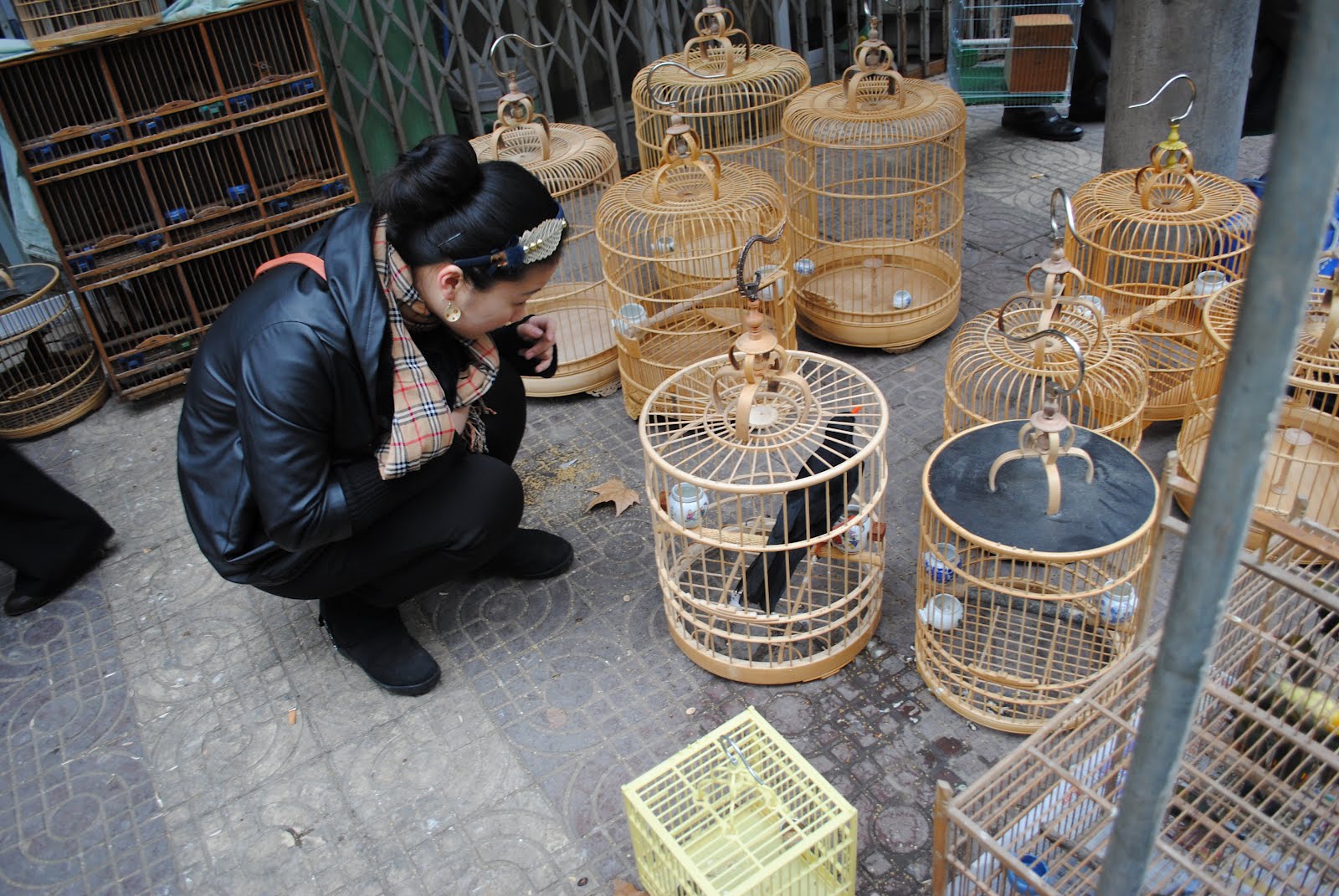
Last week, I went to a market with some members of Chinese staff at my school. One of them was in the market for a bird or two. The others ended up impulse-buying dogs, which is not so unusual a thing to do in China. They don't seem to look at dogs as requiring the amount of care and responsibility we do in the West. Either way, I was there to document the events in pictures. This was the most crowded market I have ever been in, so many of these pictures aren't perfect. I could only fight the tide so often. As is always the case with Thoughts Dowinion, if you click on these photos you will be taken to a much larger picture.

You can buy many, many things in a Chinese market. While part of this one specialized in pets, other sections sold things as varied as hardware, tea sets, and, in this case, random animal parts. They are used for medicinal purposes. Some highlights from this picture include the giant fungus, the goat or impala horns, and the bear paw.

I don't know why these massive bowls were filled with egg, fish, some unidentifiable meat, and two spices, but I bet it smells amazing in the summer. I want to say they aren't for human consumption, but nothing in my experience of China would lead me to feel safe about that as an assumption.

Countless cages and containers full of hamsters could be found. The cages, for the record, are not that small, but all the hamsters in all of the cages liked to huddle together in these tight masses. Of all the animals in a market where PETA wouldn't be able file injunctions fast enough, the hamsters were probably the best-cared for.

Answering the life-long question "How do they get the turtles to the pet store." I took a few pictures before the owner of this store said "No no no no no."

The original purpose of the trip was for Agatha to buy a bird. She wanted a bird that could talk, but they all proved to be outside her price range. Her first step down the ladder was this lovely little guy. The next few photos are of different birds in the market. The only one I can name is the Budgie in the middle two pictures. They're all nice to look at, named or otherwise.


This little guy was in the running for purchase as well. Agatha spent about a minute trying to get him to talk before it was pointed out to her that he's not a parrot. This was of great disappointment, and so he was passed over. I liked him, though. He had character.

She settled on a pair o' keets. Here we witness the sexing of the birds. She wanted a boy and a girl so that they would reproduce one day. In the name of continuing the species, the birds had to undergo this humiliation. Perhaps the shared experience will have bonded them.

Here's the happy couple, already seemingly unaware of the embarrassment they've endured. Love heals all, apparently.
The birds were in one section of the market, the fish in another, and the cats and dogs in yet a third. Above, a man stares deep into the eyes of a puppy while holding his cigarette. The Chinese for the most part view dogs as accessories, I think. Not necessarily in the Paris Hilton sense of accessories, but they aren't viewed as a part of the family like they are in the states. For example:

When Jessica bought her dog, they gave it to her in a plastic bag, much as the checkout clerk at The Home Depot would give you your bundle of wire and new hammer in a plastic bag. She still carries it around in that bag, ten days later. Below, you can see him sans bag.

I am sorry for the lack of pictures of the market as a whole to give you a better idea of the area itself. I'll keep that in mind for future write-ups.

Thursday, February 23, 2012

The China Diaries: Roll the Credits, Pt. 2

From the back of The Ides of March (great movie, by the way, and you should see it):

"Clooney plays the perfect story to the Democratic Party politician Michael Morris as the core, he was a genious, handsome, ambitious, full of leaders in the gas field, he assured the public that he would put it on their own honesty. Stephen is his team's media spokesman for the campaign, the moment of the recruits almost overshadowed the campaign team of the old leader Paul. But politics always slowly showing its own sinister..."

Sunday, February 19, 2012

The China Diaries: Roll the Credits

I was asked by a friend to bring them one gift from China, if I should happen to find it; hilariously bad pirated copies of Beatles CDs. I told him that this would be impossible, as such things are hard to come across. Generally speaking, I think what's impressed me most about China has been the quality of their market for DVDs and CDs. You don't necessarily have to look hard to spot the inaccuracies that are tell-tale signs, but you do have to look. The slip covers are professionally printed and attractive. They use the real artwork from the movies, as opposed to hilarious cut'n'paste jobs. This is all, rest assured, thanks to the internet. They have definitely stepped up their collective game, whomever "they" are exactly.

You don't buy your DVDs from a man with a cart. I mean, you certainly can, but there are nice stores for this sort of thing. One of the favorite stores in Xi'an is a place where you can pick up just about any movie you want. Their selection rivals Target, and their prices certainly beat it. As China becomes more prominent in the global economy, they have been cracking down on pirates. Without copyright laws being protected, many lucrative aspects of the world economy will never come here to nest. This puts the Chinese government in a tricky position, though; the DVD market as it stands now may not be very profitable for the industries, but it's extremely profitable for the Chinese themselves, and they wouldn't make nearly what they do now as individuals from running a Fine, Upstanding Business. The store I speak of was raided shortly after I got here. A teacher walked in one day to find that most of the DVDs had quietly been removed, replaced only with the significantly more expensive, most likely genuine articles. For a short period of time, at any rate. It would seem some of compromise has been reached wherein everyone helps to Keep Up Appearances.

Back to the product itself; there have been massive improvements, certainly, but there are still errors. And some of them are funny, in a quiet sort of way. Beyond the normal typos, there are things that are just inconsistent. For example, the case for The Artist includes the Proof of Purchase for A Bug's Life), and my copy of The Descendants includes the production credits for A Night at the Museum, save for the fact that the title of the movie is still listed as The Descendants. My favorite one, without a doubt, is a little idiosyncratic addition to the cover of the first season of Six Feet Under. See if you can spot it.


Did you see it? If you didn't, look over Claire's shoulder into the mirror. You'll see that the good people of Fischer & Sons are being haunted by a ghost straight out of The Ring. If you've seen the show, you will probably think it's worth at least a chuckle. I think it's great. It's the best kind of false marketing. Another thing I noticed while writing this: The pictures on the back of the case for Season 1 are from the final two episodes of the series, and give away everything that happens if you pay attention to them. It's the little things.

* * * * *

Don't look at me like that. I told you they were quietly funny. I gave you massive trash fires, that was pretty cool from a more typical viewpoint, and five people looked at it. So now you get to hear about DVD cases. You did it to yourselves.

Thursday, February 16, 2012

The China Diaries: The Towering Inferno

As China continues to wind down from New Years, a lot of things still aren't quite back to normal. The market next to my apartment, for example, is still less hustling and bustling than it was during its peak, as many businesses remain closed. Part of the problem, I would imagine, is the plethora of trash piles throughout the streets of the market. Below are a few pictures of the most impressive, which burnt steadily for two weeks as people continued to add rubbish to it. I should note that since these pictures were taken a few days ago, the trash has been removed. Still, it was quite a sight, and it was simply one of many such burning piles to be found in the market.


I apologise, I did not have my camera with me to take pictures during daylight.

Tuesday, January 17, 2012

The China Diaries: The America Diaries?

I took off from Xi'an's airport at 10:30 in the morning on January 16, 2012. I landed in Nashville's airport around 11:00 that night. In the intervening 12 and a half calendar hours, I managed to spend about 26 hours awake. It's a satisfying feeling. My January 16, 2012 was WAY longer than yours. Considering that I woke up at 6 in the morning, it was about 37 hours long, and I feel pretty good about that. People often say, 'If only there were enough hours in the day." Well, so long as you spend every day for the rest of your life flying from the Western side to the Eastern side of the International Dateline, you can get all sorts of stuff done.

* * * * *

The personal screens on the plane included Aliens and The Dark Knight and Fargo. I did not get as much reading done as I'd originally intended. On the upside, I did get much more awesome in my diet than I'd originally expected.

* * * * *

During the long flight, from Beijing to Chicago, I was sat in the midst of older Chinese people. My traveling companion in the seat next to me was likely in his sixties, and the married couple in front of me were doubtless in their seventies, possibly in their eighties. The stewardess who took care of my section did not speak any Chinese, and so I spent a fair portion of my time helping her talk to the people around me.

I'm the first to admit that my Chinese is not that good. I can't have any sort of conversation yet. But, my Immediately Practical vocabulary ("Do you have...," "How much is it?", "Where is...", "I'd like...", etc.) is very good, and, more to the point, my classroom instructions are well up to snuff. "Please sit down." "Don't touch that." These are things that come naturally to me now. It turns out being a flight attendant is not so different from teaching children.

Friday, December 30, 2011

2011 New Year's List

Believe it or not, this used to be a blog about music. Some of you may remember when I used to write reviews of new albums, along with the occasional essay. Simpler times. Times with more free time, really. I've spent the last four months being as busy as I've ever been, and the music listening has suffered as a result. I wish I could say I'm as well versed in this year's releases as I was in years prior, but I'm not. I'm really not.

It would be disingenuous of me to provide you with a Top 10 list. Getting past my lingering doubts about numbered lists, I don't think I've listened to most of this year's releases enough times to really get a sense of them. Having said that, I can still make some recommendations. Here are the things that did manage to bend my ear in the last 365 or so days.

Albums:
There weren't that many complete albums that held my interest, to be honest. Which could be due to my not paying attention, or maybe there just wasn't anything that really hit me right. There are albums I still want to talk about, though. A few I loved. A few were great. And a few I'm still not sure about, but I feel compelled to discuss.

Lykke Li's Wounded Rhymes was one of the two albums I really fell in love with this year. I still haven't listened to Youth Novels, her previous album, nearly enough, but that's largely because it always sounded a bit empty to me. Musically, it created the skeleton, and didn't put on the flesh. There's nothing wrong with that, of course, but on her second album, Li elected to go big or go home. The album opens with "Youth Knows No Pain," as massive as opening tracks get. It's more than that; for this album, it's a statement of intent. In her writing, she creates the same corners as her last album, but here she fills them in. Some will walk away feeling like she stuffed them to the point of bursting. It helps, I think, that her singing is so restrained. Like her Nordic sister Annie, she turns her lack of emoting (to be fair, she does a great sad) into a strength. These tracks with a voice eager to share would be overwrought and too much. But Li's lyrics need something to drive them home, and, for her, it's the marvelously detailed music going on all around her. If you get the chance, pick up the actual single for "Get Some". The non-album b-side, "Paris Blue," is intoxicating in the right mood.


Alison Krauss & Union Station were not a band I had put high up on my list of expectations for the year, but I loved Paper Airplane as much, if not more, than anything else that came out in 2011. I listened to it almost every night in June, and it's easy to see why. The title track is my favorite piece of songwriting from the last year. The cover of "Dimming of the Day" is elegant, understated, and the perfect vehicle for Krauss' crystalline voice. "On the Outside Looking In" gives Dan "Foggy Bottom Boys" Tyminski a powerhouse of a bluegrass number. And throughout the album, you are reminded of what it's like to listen to people who can really play their instruments. There aren't many bands so fine-tuned at playing together as this lot. "Paper Airplane" along is a masterclass in handling dynamics and feel. And what's truly terrifying is that they make the whole thing sound effortless.

I'm happy to admit that I jumped on the Elbow bandwagon when most people did, around the release of 2008's The Seldom Seen Kid. In that time, I've really only listened to their first album, Asleep in the Back, and their latest, Build a Rocket Boys!. They are a band that requires time, under the best of circumstances, but they reward it fully; every time I listen to one of these three albums, I like it just a little bit more. Guy Garvey writes lyrics perfectly pitched between the every-day and the grand; He's Springsteen if Springsteen didn't sometimes leave me with the uneasy aftertaste of pandering. On the music front, as with all of their releases, this is a beautiful, patient album, full moments of intense quiet and cathartic release. It makes you wonder why more bands don't take advantage of both the "loud" and "quiet" opportunities music can afford. Probably because it's so damn difficult. Elbow used to be pegged as Radiohead/Coldplay also-rans. That has always been unfair. Radiohead are far afield in their own world. Coldplay are one of the biggest bands in the world. Elbow, meanwhile, have once again quietly made the argument that they are the best.

It's an aphorism at this point that there's nothing original left to do in music. In the broadest sense, that is likely true. But I firmly believe that, working in specifics, there will always be something new to do. And lo tUnE-yArDs' w h o k i l l, an engrossing take on what popular music can be. The rhythms are always somehow jilted, but the music moves seamlessly between melodic and dissonant, between the angularly beautific ("Wolly Wolly Gong") to the riotous ("Gangsta") to the frustrated ("My Country"). As far as replay value is concerned, I am drawn to words more than music, which is why I will always rate The National above this, and Randy Newman above everything else, but the music gets you in the door in the first place. And this is some of the best music you will hear. If you like it a little weird.

It's likely this will become known as the Difficult Radiohead album, a title that seems to get perpetually back-shifted with each new release since it was first claimed by either Kid A or Amnesiac, depending on whom you ask. For my money, the difficult one is still Pablo Honey, but that's a cheap shot. The King of Limbs is definitely the low-key Radiohead album, which is both to its credit and detriment. The upshot is that it makes the outward statement of appearing calm while feeling anything but, and that's not easy to pull off. The downside? You have to pay it much more mind than previous releases, and I'm still not positive it rewards the effort. But I keep coming back to it, and I've not been the sort who would blindly follow a band anywhere for at least the last year and a half. The first half is where my uncertainty lies. But that half is texture. The second half, the songs, is hauntingly beautiful. And if none of it is knew, well, neither was anything on Hail to the Thief. I'll still get excited about the next one.

I want to spend more time with Bad as Me, but I want to spend more time with Tom Waits albums in general, so that's hardly surprising. It's harder and has more drive than what he's done before. There's no "Misery's the River of the World", in sense of arrangements moreso than tone. He takes a (modest) step away from the mad carnival director angle, and while I've yet to tire of that take, it's probably the right time. "Bad as Me" is the most immediately engaging song he's written. Everything before that and after doesn't quite stick in the mind, at least not yet; but, as I said, I'd like a
while longer with it.

St. Vincent's Strange Mercy is well worth listening to just for the second track, "Cruel," which a coworker described as the best song he'd heard in years. He might be right. St. Vincent specializes in putting together all these lovely, completely singable bits and pieces, and then slathering them with baroque arrangements and fuzzed-out guitar. It can have mixed results; her first album, Marry Me, isn't as good when you're not listening to it as it is when you are, while her second album, Actor, is flat-out awesome. I'm not sure what I make of Strange Mercy. The perfect "Cruel" aside, the songs don't come together for me. The verses are great, and then the choruses annoy me. And so it goes.

At long last, it is here. 40-odd years of waiting have seen the original tapes for the infamous Smile Sessions come out in an official release. Brian Wilson's final days as an uncontested genius on display for all the world to see. What separates it from the 2004 release of SMiLE, recorded by Brian Wilson and a few magic fairies? Well, for one, this one's actually sung by the Beach Boys. The first second of the album makes it abundantly clear as to why that matters. While the "Our Prayer" on 2004's album was beautiful, this one is transcendent. "Heroes and Villains" contains more twists and turns than most albums do. "Surfs Up" is haunting. Outside of that, I'm not so sure what I think. The music is often top-flight, but the lyrics, written by Van Dyke Parks, refuse to mean anything to me. Worse than that, they feel like they're striving for meaning. I don't mind meaningless prattle when it knows that's what it is. As for the extensive bonus material, Brian's solo demo of "Surfs Up" is my favorite thing here, including everything from the album proper.

I seem to be in the minority on Bon Iver, Bon Iver. I don't like it for reasons entirely unrelated to the embracing of soft rock. I've listened to it seven or eight times, in a multitude of settings and mindsets, and I just don't like it. I don't like how it sounds, I don't like how it's mixed. Some of it is beautiful, and Justin Vernon's voice remains an incredible instrument, but I just don't like it. It's too busy, I guess. I'm coming to piece with it. Everyone else can enjoy it, though. Don't stop on my account.

Another disappointment, ultimately, was Brad Paisley's new album, This Is Country Music. Unlike his still-masterful American Saturday Night, after a few spins, the new one smelled suspiciously like pandering. Which, too be fair, may have been an attempt to apologize for recommending on his last album that country music embrace multiculturalism. A final album note, I wish I had spent more time with Laura Marling's A Creature I Don't Know. She remains truly impressive.

Thursday, December 22, 2011

The China Diaries: The Market

Here are a few pictures I took today from the food market next to my apartment. If you press "shift" and click on them, it should take you to a blown up version.

I buy breakfast from this man five or six days a week. I don't know the Chinese name for what he makes, but we refer to it as a pancake. It's a batter cooked on a griddle into the thin circle you see in the picture, though what you're looking at there is close to the finished product. After he spreads the batter on the griddle, he spreads an egg over that, then he spreads two spicy sauces on top of that (they are the red smears you can see), then he puts chives and potato bits in. To top it off, he throws on two bits of lettuce and two pieces of Crunchy Thing, a flavorless crispy "food" that adds nothing but texture to the party. It's delicious stuff. The market has it fair share of dogs. I don't know if they belong to anyone or if they are fending for themselves, but they're friendly enough either way. In the sense that they don't bark. I'm not about to pet one, as that's where germs come from.Most of my Chinese is very practical. I don't know any strange, inapplicable words or phrases, which is something of a disappointment. The least practical word I know is probably 萝卜, a bag of which can be seen above. They're a sort of radish, I think.Chinese chestnuts are delicious when they're warm, and as a way to keep them warm in the freezing Xi'an winter, the street vendors put them in heavy velvet blankets. On more than one occasion, I've walked by the chestnuts and felt a pang of envy, as I've no doubt they are warmer than me.

Wednesday, December 14, 2011

The China Diaries: What's in a Name?

Your name is an important social construct throughout the world. For Westerners and Easterners alike, it can symbolize important relations, monetary status, reputation... Entire careers have been built on names (Nick Carter begat Aaron, Jonathan Swift begat Taylor), favors have been traded, etc. But, outside of a social context, Western names don't really mean anything. Yes, the etymology of Andrew means something along the lines of "Strong," but the name as it stands in modern times is really meaningless. I don't meet people named Rex and think, "Yes, for he truly bears the noble stature and hard nose of a great king." That I don't meet people named Rex at all is beside the point.

In the East, names still mean something. It is unavoidable in Chinese, as the characters are identical, and so a link of meaning occurs. Parents will often name their children for an aspiration or a hope. I have a friend at my school named 豆豆, which means "Bean sprout." I've yet to crack what the aspiration there was.

Many Chinese people fail to grasp that this does not work both ways. When starting a class of new learners, many of them will not have 英语名字 (English names), and so we bequeath these upon them. The parents will often ask after the class for the meaning of the moniker.

"His name is Rick?"

"Yes."

"What does it mean?"

"Uh... Rick?"

"Right."

"Er... Rick."

"Pardon?"

"It means Rick."

"Okay.

"But what does it mean?"

This can go on for ages. As teachers, we strive to create a controlled, respectful learning environment for all of our students, but I think the cracks show through when we name our students. In my first few weeks of teaching, I attempted to name a student "Ishmael" and another "Cain." Both ultimately rejected these names for "Stephen" and "John," respectively. I understand why Ishmael jumped ship, but, for God's sake, I would love to be named "Cain". I briefly flirted with naming another kid in the same class "Abel," but I didn't want to be asking for trouble. You can only do so much. One teacher recently gave two students the names "Sonny" and "Cher." They will, I assume, be partnered up in all pairs activities for the foreseeable future. There was a student recently who named himself "Airplane". The TA for the class tried to tell him that that's not a name, but the teacher said, "No, if he wants to be called 'Airplane,' let him. This is how we learn."

Funny in a less troubling way are the names students come in with. As all nouns are considered fair game in Chinese, you do end up with some classics: I have no fewer than three "Apples" in my two youngest classes. There's a "Linvida," which I still insist is not a real name. There are quite a few "Potato"s, a "Power," my roommate is teaching a "Dinosaur," and there's even a kid named "Michael Jackson," which really makes you wonder. There's a "Star" who consistently introduces herself as "Superstar." I refuse to call her this.

My own experience with picking a Chinese name hasn't been what I would call "Quite a process," but it's been a source of bemusement on the occasions when it's come up. My Chinese tutor suggested 安林杰, which is derived from my first and last names to give us "An Linjie," but that has met with general scorn from every other person in China. Taken literally, it means "Peaceful, talented grotto". But more recently, another option has presented itself in the form of 安猪, "An Ju". This is simply another phonetic transposition of my name. There are many, many possible ways of rendering my name in Chinese similar to this. But 安猪 is special. It's Chinese for "Peaceful Pig." Winner.