Tuesday, July 26, 2011

Apparition in the Woods

I have more or less come to terms with the fact that I will die. That used to be a problem for me, literally keeping me up at nights. But I've made peace with it. I'm hoping it won't be for another sixty or seventy years yet, but I am okay with the overall concept.

What still makes me profoundly uncomfortable is the concept of extinction. Serious contemplation of the sun's burning out or the universe snapping back in on itself like an over-stretched elastic can, and will, send me into spiraling bouts of depression. They do not always last for long, but they are moments when I contend with what experience shows me to be the blackest night of the soul. I can end, and that's alright, but there must be something to continue. There must be life.

* * * * *

I recently finished rereading Alex Ross' survey of 20th Century music, The Rest Is Noise. It is a wonderful book, impeccably researched, and written in such a way that you can feel Ross' love and passion for the music radiate off the page. The majority of the chapters chronicle a period and a specific group of composers. It begins with a chapter on Mahler and Strauss, and proceeds, more or less, chronologically. Ross has a gift for writing about music, and here he manages to illuminate the works of the century's great composers with the cultural and personal context in which they were written.
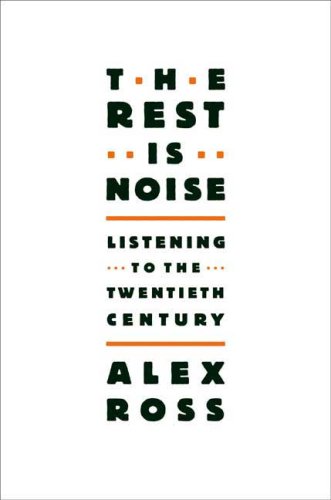
For my money, the best chapters in The Rest Is Noise are those that concern themselves with a single composer. The chapter "Apparition in the Woods," about Jean Sibelius, is far and away my favourite. Sibelius had much success in his life; he was a living National Treasure of Finland, he was well-known throughout the world, and his works continue to be performed by orchestras everywhere. Despite all this, he had the misfortune of coming to prominence during a time when a large group of composers were willfully and blindly rejecting tonality in the name of creating The New. He never received the respect of his piers, certainly not during his lifetime, and he was rarely truly happy.

The most famous piece in Sibelius' canon is likely his fifth symphony, a work of both profound beauty, and quiet innovation. The final movement is astonishing, the last three minutes a breathtaking struggle as the orchestra tries to break free from whatever is holding it back. When the players finally reach the summit, there is nothing else like it in music. Nothing else like it in this world, for that matter. When you listen to Sibelius' Symphony No. 5 after having read "Apparition in the Woods," it is a great boon to the spirit that someone who was so unhappy in life could create something of such everlasting beauty.

* * * * *

Currently, I am reading Dave Eggers' The Wild Things, the novelization of his cinematic adaptation of Maurice Sendak's Where the Wild Things Are. Max, the protagonist, is about the same age I was when I first asked my mom what death is. Last night, just before going to sleep, I read a chapter in which Max's science teacher mentions that humans will eventually be extinct, through some means or another. To Max, this is a revelation. The world makes little sense to him as it is, and this doesn't help. Eggers makes getting into Max's mind look effortless, and handles all of this with clean, simple, effective prose.

As I read, I could feel the depression creeping up. It always starts in my stomach, and spreads from there. It makes it hard to breathe, and harder still to think about anything but the end of the world. Of course I know that one day the sun will burn out, and when it does, it will likely scald the Earth. And I know that human beings will have gone extinct well before then, likely through our own fault. But I live, day to day, without those thoughts in my head, because I wouldn't get anything done otherwise. There is an interpretation of Atheism which I rather like, that this life is all you've got, so you best do everything you can. I prefer that idea to this being a 75-year SAT exam for admittance to Heaven. But I still don't want to live with it on my mind, every day. I am an Agnostic because I do not have the courage to be an Atheist.

I finished the chapter, and reached for my headphones. I turned off the light, put on the final movement of Sibelius' fifth, and listened. In those final moments, as the orchestra attempts to build, pulled back again and again by the darkness, finally emerging triumphant, it was telling me that as long as there is beauty like this in the world, it is worth existing.

You are here, it says. That's all that matters now.

Sunday, July 10, 2011

The dB's, and, The Age of Consumption

On a Wednesday afternoon, having spent the last three days packing up my apartment in Chicago, I decided to take a quick break and bike over to Reckless Records. I was only there for a few minutes, because I knew what I wanted: Repercussion, the sophomore album by '80s rock band The dB's. I bought it on the strength of their first album, Stands for Decibels, which has become one of my favorite things over the last six months. When I listened to it at home, and over many subsequent listens, it proved to be only alright.

I went to Reckless Records to buy that album solely because it had proven impossible to find online. That Wednesday was the first time in years that I'd bought an album without already having heard it. And, good album or not, it brought back something I had forgotten: the thrill of buying, not simply acquiring, new music.

The obvious perk to downloading is that you don't have to pay for it. But there is an intangible difference that going to the store, hunting through the racks, paying for the album, and having to wait until you get home to hear it bring to the whole experience. I admired the jewel case (I'd always rather fondle a vinyl sleeve, but my turntable was already packed at that point) before putting the disc in my computer. I looked at the cover art, which I've done with many an album before, but most of them were albums I'd already listened to through downloads. With Repercussion, I started imagining what the sound would be like. I had forgotten that album covers could do that.

And, probably because I had a fiscal stake in the proceedings, I found myself listening more intently. Whether or not Repercussion was terribly good as an album, it served as a reminder of what the album experience is meant to be.

* * *

I have had Tom Waits' entire discography for close to a year. I've listened to two or three of his albums in that time (There are about 20). I have had Led Zeppelin's Physical Graffiti for three years. Halfway through "Kashmir" one time is about it. Live in London by Leonard Cohen has sat in my collection, virtually untouched, since it came out two years ago. There are countless other examples of neglected music sitting in my iTunes library, and yet I could not name for you even one physical album I own which I have not listened to once or twice.

While the digital age has flattened the playing field, allowing everyone access to an endless library of music, I think it has also helped foster, subconsciously, a mentality of quantity over quality. As an audio major at Columbia College in Chicago, I regularly heard peers mention having several terabytes worth of music. I have a library of about 90 GB, less than a tenth of a terabyte, and, speaking as a voracious consumer of music, I can tell you that a collection in the terabytes is not practical. Music will sit abandoned, unheard, for eternity.

I've been vaguely aware of this downside of mp3s for two years, ever since the first time I was relieved to find that I didn't like an artist because it meant I could delete their discography from my computer. There is simply so much old music to try to take in, along with the ever-increasing stream of new music, that you start to feel like keeping up is a burden. And, as with any passion, it should never feel that way.

The other downside to such an influx of material is that you burn through an infatuation with an artist quickly. I got into and over Elvis Costello in only four or five months, because I acquired his discography in one day. My infatuation with Blur lasted years, because I bought their albums as I found them, over a seven or eight month period. The initial kick of the Blur phase and the Costello phase were equally as thrilling, but the Costello phase feels like a distraction. The Blur phase still feels like a distinct and important period in my life.

When getting into a new artist slowly, or buying a new album in a physical form, it generates its own excitement. Because you have to put effort into finding the physical object, the album builds an aura around itself, which pulls you in. Downloading an album off the web can build excitement, but it's not the same, it is cut with too much ease, and too often it just becomes another part of the library, as anonymous in that list as any other track from any other album by any other artist.

* * *

I am done downloading music. And not because I'm worried about legal troubles, or about the fiscal well-being of the artists, but because I want to go back to music being an exciting commodity. I want to feel the thrill of buying an album without knowing what it's going to sound like. And I want getting to know an artist to feel like a decision, not an afterthought.

Sunday, July 3, 2011

101

101
Keren Ann

Pop music is all about the sound. The writing is secondary. That's not to say the writing is less valuable, as the best bands are those where the writing and the sound come together in glorious, glorious congress. But the sound is where it starts, even for the writing snobs such as myself.

In movies, great acting can make an alright movie very, very good. "Rachel Getting Married" comes to mind. But in pop music, a great sound can make a mediocre song mind-blowing. "Be My Baby." I need say no more.

This brings us to Keren Ann. Her songs are... they're good. Often just alright, honestly. For my money, she's only ever written one exceptional song, "Lay You Head Down". But hers is a sound that makes me want to cry. And I mean that as a compliment.

Her new album, 101, changes none of this. The songs are... decent. None of them stand out in my mind, save for "Sugar Mama," which someone should have told her to cut from the final product, and "101", which I'm going to give its own entry in a few days. But the album is hypnotically, even perversely, listenable. The sound of the music and the sound of her voice are a wonderful combination. Her lyrics are often clever in a pleasantly ignorable sort of way. But the songs themselves just don't stick with you. The whole almost never equals it's parts. This has been a consistent problem throughout her career.

I should note that I really enjoy Keren Ann. I don't include her on my list of favorites, but I did get very excited when I found out she had a new album coming out. I don't fault her for not writing better songs, because she never sounds like she wants to; it's almost as if she writes the songs she does only because she needs skeletons to hang her arrangements on. If I didn't love the sound of her voice, I would say she should become a producer. She's that rare artist who has a sound so good, and it is good, that it completely and utterly transcends her songs. There are countless artists who would kill for that.

Friday, July 1, 2011

Glenn Beck: Why Can't I Hate You?

The final episode of Glenn Beck's daily television program aired on Fox News yesterday. In honor of the occasion, I am reposting, with revisions, my post from two years ago, "Glenn Beck: Why Can't I Hate You".

* * * * *

Glenn Beck.

For those of you who do not know of Glenn Beck, he is a conservative pundit. Glenn Beck is the most recent to hit the popular stride, following in the hallowed path of Bill O'Reilly and Rush Limbaugh. Beck isn't quite as hard-lined right in his beliefs as his forefathers, but that's part of what I don't like about him; You don't get the impression that Beck actually believes in what he's saying so much as he knows he isn't a liberal, and he knows he can get attention by not being a liberal as loudly as possible. Like America during the Cold War, he's not defined by what he is, but by the fact that he's no commie.

Here's my thing about Glenn Beck: I want to hate him. In fact, I think a bit of me does. Most of me, even. What the hell? All of me. I hate Glenn Beck. I also hate Rush Limbaugh. I despise, on an even deeper level, Anne Coulter. They have, all three of them, made names and fortunes for themselves by saying things I'm not even the slightest bit convinced they believe. And there are few things I find more deplorable than that.

But this is all irrelevant, because I can never tell them I hate them. I can never say to Glenn Beck, "Glenn Beck, sir, I hate you." Even if, when you say it, it is a completely rational, thought out, well-contemplated notion, it does not matter. Because you cannot use words like "hate" around Glenn Beck.

Using words of intense passion around men and women like Glenn Beck gives them an excuse. It gives them an excuse to say things like, "I told you so." If you react to their extremism with extremism, if you try to fight fire with fire, they throw their hands up, and they say, "Well, sir, if you're going to be irrational about this, and you're not going to be considerate and civilized, and give me the common courtesy of real conversation, I'm not going to take part in this." You have to remain right in the middle of the road, and uninteresting. If Beck riles you up, you are playing into his hands.

And before I am accused of playing along a party line, it is not Beck's beliefs that cause me issue, disagree with many of them though I do. I assure you I disagree just as much with Bill Crystal, the editor of The Weekly Standard, a conservative magazine. But I have seen Mr. Crystal interviewed on several occasions, and he is always polite in the face of dissent. He is able to have a conversation about his views, to hear the other sides and to defend his in a manner which is dignified both for him and for the person he's talking to. Glenn Beck, Rush Limbaugh, and Bill O'Reilly on his bad days, cut people's mics, or talk over them, or end the segment.

If I say "Glenn, I really hate you," in many ways I am paying him the greatest compliment, and providing him with the greatest service, possible. And so I have to keep it all inside, where it can stew, and boil, and grow, until finally the day comes where I can't hold it in anymore, and I look Glenn Beck square in those beady little eyes of his, and I say, "Glenn Beck, I hate you." And on that day, he'll look at me and say, "See, I knew it, people like you just can't handle being disagreed with, can they?," and he'll have won.

That's why I can't hate Glenn Beck; because I really, really do.

Wednesday, June 29, 2011

Cheap Shots

Helplessness Blues
Fleet Foxes

The first thing I'd say about the sophomore Fleet Foxes album is that it's gorgeous, and it is. Astonishingly so. But I don't like it when that's the first thing I'd say about an album. They have a beautiful, refined folk sound all their own, and their writing is good. But when you apply that breathtaking vocal sheen to everything on an album, it bleeds together. I had the same problem with their debut, but at least I catch myself humming bits of it every now and then. When what I remember best is the acid-jazz sax freak out in the middle of a ten minute song towards the end of the album, it serves to remind that walking away thinking "God, that was gorgeous" doesn't mean I'll be walking back again any time soon.

Gloss Drop
Battles

Math rock doesn't even sound inviting. I rarely go for it. But, with Battles, I have a history. I bought 2007's Mirrored during a brief phase where I was trying to like weird music. This was the same time frame in which I purchased my first Wilco album, and Brian Wilson's Smile. It was an awkward time. I picked up Gloss Drop much as I still pick up a new Wilco album. Like it or not, I feel I owe it to my younger self. Gloss Drop is, as one would expect, a technically impressive album. It has moments that are really enjoyable, but it is mostly music for the sake of music. For me or not (it's not), there's nothing wrong with that. Still, what I ask is clearly not impossible. Gloss Drop made me go back and listen to Mirrored again, and I tell you what, that is an impressive and enjoyable album.

House of Balloons
The Weeknd

In this day and age, is there a difference between a mix tape, an EP, and an LP? Debatable. This is technically the first, though it could easily be any of them. It's long enough. And it's good enough. Imagine if early-period Portishead were just slightly more ethereal, frequently used the word "shawty", and sang about doing lots and lots of cocaine. Not as much of a stretch as you'd think. And, like Portishead, The Weeknd never give you the high. Just the aftermath.

Cults
Cults
I learned about them from Pitchfork, which right away tells me I should be suspicious. But, honestly, I really like the cover. And I appreciate what they're doing here. A throwback, writing simple and infectious songs about relationships. I'll give them time. It will either be their proving or their undoing. Even on the less-impressive tracks, there is a youthful hum and vigor here, particularly on opener "Abducted" and closer "Rave On," which is, lets be honest, what pop is all about. But I'm not so sure there's anything else, and you can't live off of hum and vigor forever.

Sunday, June 26, 2011

Something in the Water

It seems to have all started with ABBA.
The first indications of the genetic mutation which predisposes the Swedes to being absolutely brilliant pop songwriters could be seen in the stream of albums released by Anni-Frid, Björn, Benny, and Agnetha during the 1970's. Nobody else could write songs as cunningly catchy as "Waterloo" or, lest we forget, "Dancing Queen". After they broke up in 1982, the mutation went dormant for about 15 years, but they were clearly an indicator of what was to come. Think of them as the Magneto or Charles Xavier of the Swedes.

The new class started to make themselves known with the Boy Band craze at the close of the last millennium. I could have said century, but Max Martin, the Swedish Svengali responsible for a remarkable array of hits ("...Baby One More Time", "It's My Life," "Since U Been Gone," "Raise Your Glass", and "I Kissed a Girl" are but a meager portion of his contributions to radio's Top 40 over the last 15 years), wrote half of the songs on Backstreet Boys' Millennium, one of the more successful albums of all time. I'm aware of Martin's contributions to pop music, and I'm still stunned every time I read his curriculum vitae.

One of Martin's first successes was in 1997 with, naturally, a fellow Swede, pop siren Robyn. Their powers combined to give the world "Show Me Love," which remains one of the better singles of the era. After a weak second album, Robyn took some time and returned five years later firmly in control of her own career. Working primarily with Swedish writer Klas Åhlund, the self-titled album she released remained an unequaled piece of art-pop perfection until her own series of Body Talk albums came out last year. It seems that the only person in Robyn's league at the moment is Robyn herself.

Martin is unapologetically commercial, and there's nothing wrong with that. ("It's Gonna Be Me" by 'N Sync just popped up on shuffle. It's Martin.) Robyn is beating out her own path, making music that should, by all rights, be hugely successful, but manages to stay just below the radar. Commercial viability aside, they are both clearly touched by the same blessed mutation as the mighty ABBA.

With her new album, Wounded Rhymes, Lykke Li makes a serious argument for being granted membership into this formidable and exclusive assemblage. While her first album, Youth Novels, was very good, and very catchy, it lacked the clear display of ambition necessary to gain full rights. If she wanted to bring any guests in to use the pool, Robyn, Max, or Klas would have to sponsor them. Wounded Rhymes is a different beast entirely. Where Youth Novels had a delicate, almost mock-low-fi aesthetic, Wounded Rhymes is a pop leviathan. It is loaded with dense, elephantine beats, perfectly conveyed by opener "Youth Knows No Pain" and standout "Get Some." Tucked in between the rumblers, the are gentle songs such as "Unrequited Love," a song in 6/8 which is played with appeasing lack of precision and cast Lykke as a girl at the corner of the bar, bemoaning her misfortune. The title is derived from the lyrics of "Sadness Is a Blessing," a sublime Phil Spector pastiche. It is loaded with unique electro-pop touches, some tucked way in the back of the mix. It is ear candy with a serious brain. It may be my favorite album to come out so far this year. Whether or not it holds that distinction until the end of the year, it makes me grateful for whatever those Swedes have been putting in the water.

Saturday, June 18, 2011

You & I

One of the distinctions between an art and a science is that an art cannot always be explained.

For example, "Why do baking soda and vinegar volcanos work?" can be met with "The acetic acid in the vinegar engages the sodium bicarbonate in the baking soda in a double replacement reaction, and what little baking soda isn't broken down overflows as the produced carbon dioxide expands within the confines of the volcano." But ask me why those final, mighty chords in Beethoven's Fifth always send chills down my spine, and you'll likely get no more than a shrug.

This is, of course, one of the appeals of the arts. Munch's The Scream is a strangely captivating painting, and you can't really, for all the art history and composition and color theory classes in the world, tell me why. You can explain the parts forever, but they will never equal the whole.

Yesterday, for example, I spent about fifteen or twenty minutes listening to The La's' "There She Goes?" over and over again. It is a good song: The lyrics are generally about love without being inane (the pop equivalent of being an instrumental, really), Lee Mavers' voice has a nice combination of the sweet and the gritty (It occurred to me yesterday that I would love to hear Spoon take a crack at this song, actually), and all the guitar parts are hypnotically simple. But I can name about 1,000 other songs with the same qualities. So what is it that makes this one song so compelling? You can't tell me, and I can't tell you. It is the simple magic of the pop song.

This is what we are accustomed to with music. We cannot explain what separates the very good from the transcendental. Same goes for individual lyrics. It's been well over a year since I heard "Conversation 16" by The National for the first time, and I'm still reeling from "I tell you miserable things after you are asleep." This is a poor example, because that lyric is so brilliant in how it encapsulated the situation that it speaks for itself. So how about this: In the Robyn song "Get Myself Together," she drops the line "I can't tell what's right or wrong, and I wish that something could be done, but I'm not that clever." Every time she sings "I'm not that clever," I can feel it in my heart. And I have no idea why. Again, though, this is within a good song.

I'm significantly more interested in when this happens with music we may not normally give much credence. On "You & I", the otherwise unremarkable new album by The Pierces (a conventionally attractive sister duo who somehow managed to become friends with the bassist for Coldplay), there is one song, "We Are Stars," that seems touched by this magic. "I could think of nothing worse than to sail this universe without you," either the blonde one or the Burnett one opines. And I find it genuinely moving. In the middle of a soppy song in the middle of a soppy record. Yet I keep returning, time and time again, to experience that moment. If only they could figure out how to make that magic last the length of a song, or even an album.

But, of course, if they do that, they'll have found the pop equivalent of the Holy Grail.

Location:Boston, MA