Tuesday, August 25, 2009

Ba! Humbug!

Humbug
(2009)
Arctic Monkeys

It is a strange relationship I have with this band, it really is. They never blow me away on record for more than a song or two; listening to all of 2007's Favourite Worst Nightmare leaves me feeling somehow underwhelmed, and the same goes for Whatever People Say I Am, That's What I'm Not. For a song or two, they get the job done, and they get it done well. But not, for my money, over the course of an album, and every now and then I find their song structures to be terribly twee. For every time I find "Fluorescent Adolescent" to be an enjoyable, summer-tinged romp, there is a time I find it to be just shy of the mark, erring to the side of grating. Ah, well.

Having said that, they blew me away when I saw them at the Riviera here in Chicago two years ago. I mean, really, they were staggeringly brilliant. Not much in the way of banter or charismatic stage presence, but they were as tight a live band as you'll ever hear. The point is, heading into this latest offering, their third, I'm still not wholly convinced I believe in these Arctic Monkeys as the next saviours of pop music.

The only song I've ever loved, unconditionally, to come from the pen of Alex Turner and company is "If You Found This It's Probably Too Late," a barnstormer that served as the intro to their Brianstorm EP. It promised dark, heavy things, a sound which I think suits this increasingly-less-than-merry band. There aren't many modern bands making heavy music you can sink your teeth into, and I'm not talking about music that pummels you, so much as music that simply feels heavy. Like Queens of the Stone Age. Which is appropriate enough, since QOtSA singer, guitarist and all-around mastermind Josh Homme serves as the producer here. I like his effect on the band. It bodes well. This set's a bit lacking in parts, but the direction they're aiming is one I like very much. And Matt Helder is an amazing drummer. Listen to it, it may ultimately prove essential. What's so promising here, though, that neither previous album has managed, is that, in listening to it from the beginning to the end, I find I am more fond of what I am hearing as it ends than I am of what I hear when it begins. That is a good sign.

Grade: B+

Saturday, August 22, 2009

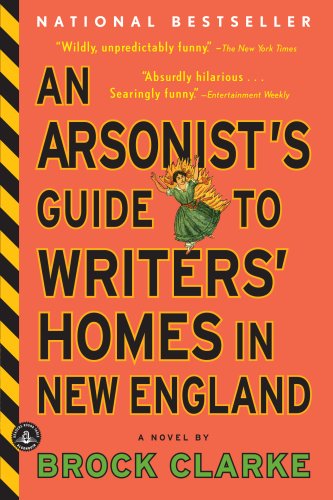
An Arsonist's Guide to Writers' Homes in New England

An Arsonist's Guide to Writers' Homes in New England
(2007)
Written by Brock Clarke

I read the reviews included in this book, and I can't help but feel that I missed something. The included reviews are absolutely glowing. They all seem to have loved this book. I, uh, I don't understand. The Pittsburgh Post-Gazette recommends the book "to anyone, and especially anyone who wants to read the best, newest manifestation of great American writing." ...right. Listen, people, I've read Mark Twain, which I think we can all agree was one of the first manifestations of great American writing, and, let me tell you, Brock Clarke is no Mark Twain.

There are a lot of things wrong with this book. For one thing, I found the main character, Sam, to be absolutely infuriating. He gets himself into a tough spot by lying, which, we can admit, happens at one point or another to everybody. I, for example, have a single customer at work who thinks I have a very thick Australian accent, and he shows up once every week or two. When I see him, I panic, and go back into the accent, rather than explaining to him that I had an Australian friend over that week, and had picked it up from her. Anyway, Sam, the protagonist, gets himself into a complicated situation by lying, and, when confronted with an opportunity for an out, he lies some more. I almost stopped reading there, on page 25, but I have a bit of a quota to maintain, so I persisted in going on.

I have to compliment Clarke on his ambition; he attempts in the course of these undercooked 300 pages to tackle just about every major emotional truth in existence. And some of them are very well conceived; to quote my own lyrics, may I be so bold, the concept is good, but the execution is off. A number of these moments happen, and are then followed by Sam, in first-person narrative, saying, "It was then that I realized...," and explaining the moral of that little story. It's somewhat akin to the way Stan and Kyle used to end each episode of South Park, only without the knowing wink and smattering of self-awareness. He either didn't trust the audience to think for themselves, or he's a lazy writer... the former makes him pretentious, and the latter makes him, well, lazy, and I'm not sure which is worse. With a little more showing, as opposed to telling, this book could have been twenty-to-thirty pages shorter, and a lot stronger.

It is meant to be an absurd book, with characters that are outlandish, but even outlandish characters have to hit the right mark, and Clarke fails on that level. It is, ultimately, an entertaining read, if you can get past the fact that you don't really care about what's happening, that the characters could never exist in real life (in the bad way), and that what you're reading could have been written by a high school student. I know, I'm a snob, but it only has 2.5 stars on Amazon, so I can't be the only one.

Kudos, though, for the idea: "I went to jail for accidentally burning down Emily Dickenson's house, and two people died in the fire because they sneaked in to have sex in her bed" is one of the best concepts for a crime I've ever heard. A shame it was wasted here.

Grade: C-

Friday, August 21, 2009

Ponyo

Ponyo
(2009)
Written and Directed by Hayao Miyazaki

I'll start by telling you, at point-blank, that the visuals alone are worth the cost of admission to see Ponyo, the latest film from Japanese master Hayao Miyazaki. The backgrounds are often rendered in an almost child-like manner, with crayons and loose shapes; it's stunning to see. The animation itself is perhaps the best of Miyazaki's career; if it's second to anything, it's second only to the visual splendour of Princess Mononoke, and that, without exaggeration, is one of the most beautiful movies in all of cinema, animated or otherwise. So, then, it looks damn purdy.

What of the story? As with every Miyazaki film, it requires from the audience a certain amount of patience; the world doesn't explain itself to you, so much as you come to terms with the idea that this film's reality works in such and such a way, and you might as well accept that. Each of Miyazaki's movies has required such an effort, if you can call it that, from the audience, and each has required it more than the last, but Howel's Moving Castle, Miyazaki's last picture and arguably one of his weakest, seems to have represented his more esoteric tendencies at their peaks. In short, less diffused wording, Ponyo is simply easier to follow, and easier to enjoy.

The story is sort of about a boy who finds a mermaid, and then they have an adventure together. That's an awful, awful misrepresentation, and it doesn't relate to you the charm, the humour, and the beauty at the core of it, but I don't do summaries, really, so I won't try. What you need to know going in is that this is as magical a story as Miyazaki has written, and it's the spiritual heir to his masterful My Neighbor Totoro, which is to say it is his second "children's" film. That is a comment meant not in a belittling sense; a young child is unlikely to find Nausicäa all that entertaining, and Spirited Away could even frighten them, but Ponyo is adorable enough, and colourful enough (Oh, sweet merciful Jesus, the colours), and relatable enough, with both main characters being five, that younger members of the studio audience will enjoy it just as much as the bigger ones. I should know; there were a number of young'ns at the show I went to, and, if the sounds they made were any indication, they loved it. One girl, in fact, very helpfully pointed out rather loudly that "Ponyo is tired." It, uh, it was funnier if you were there.

Miyazaki is a brilliant man, no question. He can bring out the magic in anything, and he knows well enough to let it flourish. After the relative misstep of Howel's Moving Castle, and the participatory requirements of Princess Mononoke and Spirited Away, Ponyo is as purely enjoyable a film as Miyazaki has ever made, and it takes all the best qualities of his canon- the magic, the humour, the beauty- and presents them in their simplest form. One of his best films, and that's no small accomplishment.

Grade: A+

Thursday, August 20, 2009

"Haf Ta? Of Course You Don't Fuckin' HAF Ta!"

Indulge me, if you will, in a discourse on the language. I want you to read the following sentences, quietly, to yourself, only in your head, then read them again, out loud:

"I have two."
"I have to."

Having read them out loud, once you knew the intent of each sentence, did you notice something? Did you feel the way your pronunciation of "have" in the second sentence became more of a "haf," more of an eff than a vee? This is not a bad thing. From what I can tell, this distinction between uses exists in every native English speaker, regardless of where they come from, how they were raised, and it seemingly happens regardless of the propriety of their diction (trust me on that one).

So I have a proposal, a modest one that involves little more than changing the English language, to distinguish between "have," and "haf," to recognize them as two independent words, with different meanings. These meanings, of course, would be linked, as they have the same root, or, rather, "haf" is a progeny of "have."

It could be seen as nitpicking, and, indeed, it is, but here's my argument: in addition to having developed entirely independent pronunciations, both words managed to form their own meanings. "Haf" is a more specific brand of "Have." For the dictionary crowd, here's how it would look on paper:

Have (verb): To possess; I have two.

Haf (verb): To possess the need; I haf to.

Tell me this doesn't make sense. Do it. I know, you probably haven't thought about it before, and that's why I'm here, to think about these things for you. If God has a sense of humour, and I think he's proven on more than one occasion that he does, you'll start to be bothered by this distinction. You'll be having pleasant conversation with friends or families, when one of those present will use "have" and "haf" in relatively rapid succession, and your attention will be drawn to it, and you will be bothered. I haf to hope so, at any rate.

Friday, August 14, 2009

Wilco (The Blog Post)

Wilco (The Album)
(2009)
Wilco

It's rewarding, to keep pushing at something until you "get it." I didn't get past "Wilco (The Song)" the first five or six times I attempted to listen to this album. There was something about it that didn't sit right. I couldn't tell you what it is, and now that it's gone, I thoroughly enjoy it, but something wasn't hitting me in the right spot. Having said that, this morning, I cracked it open again, and I was delighted.

I cannot claim to be, nor have I ever posited, that I am an expert on Wilco. Theirs is a brand of music which has always eluded me. I own Yankee Hotel Foxtrot, A Ghost is Born, and Sky Blue Sky, but I've never really enjoyed any of them beyond the superficial. Having said that, I am one of the only people I know of who enjoy- enjoy- the buzzing, clicking soundscape at the end of "Less Than You Think," so I don't find their work completely alien. One of the strong points of Wilco has always been that, for all their sonic experimentation, Jeff Tweedy has always kept the melodies very plain, in a good way. The frames of these songs are simple; it's the clothes that are damn fancy.

Wilco (The Album), opening with "Wilco (The Song)," and put out by the presumably recently-rechristened Wilco (The Band), is assured. That's probably the best way to describe it. They know what they're doing, and they do it. This is not to say they have reached the point of Knowing How to Make a Good Record. No, no, nothing like that. Wilco have always kept that part of the process interesting. But here, with this album, we get the sense that things have leveled off, and now Tweedy might actually be having fun. The opening song is meant as a lark, and it's a good one. Just remember, "Wilco, Wilco, Wilco's gonna love you baby."

It's a bit of a return to the alt-country from which all post-Foxtrot works have deviated. "I'll Fight" is almost an entirely "normal" alt-country ditty, which, again, isn't a bad thing. This is the Wilco album I'm most likely to pop back on again in a year or two. "You Never Know" is one of the best George Harrison songs George Harrison never wrote. That sliding guitar part screams out All Things Must Pass, something you don't get that much of anymore. It's a nice touchstone. Having said that, this doesn't reach the artistically daring heights of their earlier albums, and, it turns out, beneath the flashy exterior, Tweedy's much more normal than some would like to think.

Grade: B

Thursday, August 13, 2009

Glenn Beck: Why Can't I Hate You?

To the left, you see Glenn Beck. Take a moment. Take it in. Those who may wish to may praise him, or, you know, vomit.

For those of you who do not know of Glenn Beck, he is a conservative pundit on television. Glenn Beck is the most recent to hit the popular stride, following in the hallowed path of Bill O'Reilly and Rush Limbaugh. Beck isn't quite as hard-lined right in his beliefs as his forefathers, but that's part of what I don't like about him; Much like Anne Coulter, you don't get the impression that Beck actually believes in what he's saying so much as he knows he isn't, and knows he'll get attention by loudly not being, a liberal. Like America during the Cold War, he's not defined by what he is, but by the fact that he's no commie.

Here's my thing about Glenn Beck: I want to hate him. In fact, I think a bit of me does. Most of me, even. What the hell? All of me. I hate Glenn Beck. I also hate Bill O'Reilly and Rush Limbaugh. I despise, on an even deeper level, Anne Coulter. But this is all irrelevant, because I can never tell them that. I can never say to Glenn Beck, "Glenn Beck, sir, I hate you." Even if, when you say it, it is a completely rational, thought out, well-contemplated notion, it does not matter. Because you cannot use words like "Hate" around Glenn Beck.

I should point out now, this is not meant to be a one-sided attack. I just don't know the names of any extremist liberal pundits. But, rest assured, I hate them too. But I still can't tell them.

Because using words of intense passion around men and women like Glenn Beck gives them an excuse. It gives them an excuse to say things like, "I told you so." If you react to their extremism with extremism, if you try to fight fire with fire, they throw their hands up, and they say, "Well, sir, if you're going to be irrational about this, and you're not going to be considerate and civilized, and give me the common courtesy of real conversation, I'm not going to take part in this." You have to remain right in the middle of the road, and uninteresting. If Beck riles you up, you are simply playing right into his hands.

If I say "Glenn, I really hate you," in many ways I am paying him the greatest compliment, and providing him with the greatest service, possible. And so I have to keep it all inside, where it can stew, and boil, and grow, until finally the day comes where I can't hold it in anymore, and I look Glenn Beck square in those beady little eyes of his, and I say, "Glenn Beck, I hate you." And on that day, he'll look at me and say, "See, I knew it, people like you just can't handle being disagreed with, can they?," and he'll have won.

That's why I can't hate Glenn Beck; because I really, really do.

Monday, August 10, 2009

Naked

Naked
(1998)
Written by David Sedaris

Inspired by the final, titular essay, in which Sedaris details his week spent at a nudist colony, I am writing this in the buff. It seemed the only proper thing to do, really. Granted, I'm getting some odd looks from my roommates, but I'll soldier on.

Reading a book by David Sedaris can often become a futile effort to seperate the facts from the exaggerated facts. You have to let it go, not worrying about whether or not any of these stories are true. Of course, they all are; some are just significantly more embellished than others. It took me two books to come to terms with the concept of David Sedaris, fictional character, a completely seperate being from David Sedaris, author. Are they similar? I don't doubt it, even a bit. Same with his family, including his famous sister, Amy Sedaris, whom you might know from Strangers With Candy. They are represented here not as they were, or as they are, but as Sedaris, the character, envisions them to be. This is not to say any of them are far off the mark, but you can't take everything at face value, and the effort relaxes, and you start enjoying his writing for the clever absurdity it is.

There is humour everywhere in these pages, though it does not quite reach the heights of MTPOD. There were two moments that made me laugh harder than anything I've ever read, one in the immediate- a black conman comes into a job to work with Sedaris speaking like Sambo-, and one in the long run; I have been laughing at a visual involving Sedaris' attempt to flee Greece, in a manner not entirely unlike that of the Jesus Lizard, for four days now.

Like most humourists, Sedaris is improving with age, but Naked is still an excellent collection. I recommend starting here, and working your way up; he'll just keep getting better that way.

Grade: B