Showing posts with label Grade A. Show all posts

Thursday, May 13, 2010

High Violet

High Violet
(2010)
The National

The National's lyricist and lead singer, Matt Berninger, has a gift for summarising the desperation of life. Not the epic, Arcade Fire-type, where the world is crashing down on us, nor the Joy Division brand, where everything is miserable. His lyrics, combined with his simple, no-frills delivery, make for quietly devastating statements. Everywhere. And they are, I think, what ultimately make The National special.

The music is great, and I wouldn't call The National a lyric man's band, but everyone has to admit that The National are kind of boring. They make it work, and that in itself is remarkable, because I've heard a thousand bands that sound like them, but none of them are as good. The Dessner twins, responsible for the lion's share of the music on every National album, are reliable. I do not focus on their contributions when I listen to National albums, but I'm trying to balance out my presentation so as not to overlook them. They construct beautiful tracks, and over the last three albums, they've crafted a unique sound for the band. Throughout High Violet's eleven songs, The National sound like no band except The National, which is an impressive thing.

But my attention is on Berninger. During "Conversaton 16," he gently follows up the chorus of "Cos I'm evil" with a simple statement of "I'm a confident liar." He sounds like he dislikes himself as much as the rest of us, but, unlike most singers, he doesn't make the mistake of feeling special for it. It's difficult to quantify, or to relate properly, but it's really an astonishing thing. "I won't be no runaway, cos I won't run," Berninger insists on "Runaway." You can read it one of two ways: The narrator isn't a coward, or the narrator is just too tired to bother fleeing. I always read it the second way, but the ambiguity is what makes it work so well.

This brings us to the album's best track, standing out head-and-shoulders above a set of songs that already stand out head-and-shoulders above most other music of late: "Bloodbuzz Ohio." It is, like "Mistaken for Strangers," the perfect The National song. Peculiarly propulsive drumming beneath a fairly gentle track, and lyric nuggets everywhere. "I still owe money to the money to the money I owe,/ I never thought about love when I thought about home." It may not read like much, but the effect is indescribable. I've listened to this song easily twenty times since last Wednesday, and it hasn't lost any of its effect. It is at once uplifting and humbling. It is massive but remains intimate. "I never married, but Ohio don't remember me." It is the perfection of Berninger's persona, of The National's gently surging sound, and it's the best song you'll hear all year. "Bloodbuzz Ohio" is a classic. And, like their last album, Boxer, so is this album.

For a small band from New York, The National have become the forerunners in making Music that Matters. It's a tricky thing to do, and they handle it brilliantly. U2 have been trying to make an album that feels this good for the last 20 years.

Wednesday, November 25, 2009

American Saturday Night

Fact of the matter is, most of us write off country. This is not entirely our fault, collectively; There are two kinds of country, and one of them really, really sucks. The kind that sucks, "country," is the sort that tends to dominate the airwaves today. It's bland pop with a twang and lyrics that not only aim, but pander directly to, as much as I hate to bring politics into this, "Real America." The music is boring, and the lyrics are "folksy" in that patronizing sort of way. But I've been told I just don't understand the concept of easy entertainment, so maybe this is my shortfall.

At any rate, the good kind of Country, "Country" (with a capital "C," as opposed to the lower-case), is Johnny Cash, Willy Nelson, and Hank Williams. I refer to this, with the wonderful sense of superiority you can only get from a condescending maxim, as "Real Country." What separates Country from country? Well, there are a lot of things. There's a genuine element in Country which is sorely missing in country. And country sounds like someone took a belt sander to Country, removing all the interesting bits that gave it a feeling all its own. They, and by "They" I suppose I mean "The Country Man" or some equally ambiguous, omnipotent bastard, made it really boring.

The future of "Country" is looking pretty bleak, really. Which brings me to an exception to the rule.

My parents listen to country. They don't enjoy Country, though both will lie to you and say they do. The point is I spent a lot of time in the car with them during high school, and most of the music was less than enjoyable. I started grabbing onto certain songs I could find a thrill in. This was during my musical awakening, of course, and anything I could grasp, to make the ride less torturous, was appreciated. There was "Friends in Low Places," which is just a great song, no matter your tastes. There was a nice cover of "Here Comes My Baby" by, uh... that band... yeah. But there was also "I'm Gonna Miss Her." It started simply enough, and, being fair, it started with a roll of my eyes. It opens slow, a man discussing his proclivity for fishing, and his wife's disapproval of said fishing. She meets him at the door, and gives him an ultimatum; you go fishing today, and I'm leaving. I listened to all of this with the withdrawn disdain only high schoolers seem capable of mustering (the rest of us have learned it's really not worth all the effort). But then the song did something unexpected.

The tempo picked up, and Brad Paisley, as that was his name, declared, "Well... I'm gonna miss her." It's such an inspired moment, so well-realised, so without artifice, that you smile. I smiled. Yes, I broke my condescension, my ever-important sense of superiority, and smiled. I even enjoyed it. So "I'm Gonna Miss Her" joined my list of exceptions to the rule, those country songs which I could enjoy. (For the record, I consider "Friends in Low Places" to be Country)

I started keeping an ear out for more Brad Paisley. Over the ensuing months, I started noticing not just that his songs were funny and had a personality, but that his guitar was on fire, seemingly as a regular condition. This is a man I would rank in the Top 100 guitar players going today, with a strong, strong eye on my Top 20 faves, all time. He's that good. And that subtle, too. These are country songs, after all. So there are solos, but they are short. It's his lead work during the verses that really impresses. Limber without being showy.

This year, Brad Paisley released his seventh album, American Saturday Night. The reviews for it were splendid, and so I decided to venture forth and acquire a copy of a country album. This is new territory for all of us, I'm sure. Before I continue, I should note, that this album is brilliant, and you should buy it. Now.

One of the things Nashville albums are known for, to the extent that it has to be accounted for when reviewing a country album, is filler. A typical Nashville record has four or five singles, and the rest is detritus, used to fill the space. This album doesn't have any of that. Every track here, and I never say this, could be a single in the right context. A few are too slow, too subtle for that to happen, but they could be.

The songs here manage to be clever and heartfelt. They're original while staying familiar, which is a high compliment for country. Remember, this is meant to be enjoyed. It's not Animal Collective; you aren't supposed to work at it. It is simply meant to be. And it is. The melodies will stick in your head, and so will the lyrics. Is it schmaltzy? Of course, but in just the right dosing. "Anything Like Me" is about Paisley's first son, saying "It's safe to say that,/ I'll get my payback,/ if he's anything like me." At the moment, it's my favourite song on the album. Paisley's greatest strength is his honesty; "The years are gonna fly by./ I already dread the day,/ he's gonna hug his momma, he's gonna shake my hand, he's gonna act like he can't wait to leave./ But as he drives out,/ he'll cry his eyes out,/ if he's anything like me." Say what you want, but not only is it enjoyable, it's affecting; it made me feel fuzzy inside. The only other album to do that this year? Merriweather Post Pavillion, by Animal Collective. I just blew your mind.

So here we have an album that's hits, and only hits; this could have been released as a best-of, and I'd have believed it. And here we have a formidable songwriter operating at what I can only assume is the peaks of his powers. And here we have a backing band in peak shape, sounding like their having fun! Weird!

Brad Paisley makes country. He does. I can't pretend he doesn't. Yet, yet, his music, it's clever, it's original, it's genuine, it's touching, it's fun, for fuck's sake! And it has a bit of a honky tonk, swingin' personality to it, which makes it musically interesting. So maybe it's Country after all, and maybe the future isn't looking so bad as far as that goes.

Friday, November 20, 2009

This American Life

"This American Life" is a program hosted by Ira Glass. Some of you will be familiar with it. Most will know it from National Public Radio, where it has been broadcasting for the last (almost) fifteen years now. I've listened to the program once or twice, though I can't claim to be a regular contributor to the ratings.

For two seasons, one in 2007 and one in 2008, This American Life was a television program on Showtime. Each season consists of six episodes, all but one of which are just shy of thirty minutes long. Each consists of anywhere from one to four stories, all revolving around a loosely observed theme for the evening. I'll not that these themes were very, very loosely observed.

It is, I should warn you, a quiet program. There's no flash to any of the stories, as they are all, get this, real. They are all true-to-life things which could happen to any of us at any time. The narrators are subdued, and the stories are refreshingly bereft of an angle. It's all honest reporting, or very natural story telling. This is not to say This American Life doesn't have a sense of humor; the second episode of the first season closes with five minutes of a woman reading her (real) eighth grade diary to a crowded room, and it is hilarious from start to finish.

Whether laughs are had or not, the real magic in This American Life is its honesty. The people under the watchful eyes of the cameras don't hide anything. They don't attempt to, either, which is just as important. The stories are varied, taking in retirement home residents who decide to make a movie, a pair of boxers fighting for their low-level careers, a thirteen-year-old who has vowed never to be in love... the most stunning episodes are also the most unexpected. There is an episode which started as a film about the filmmaker's favorite people, but ended up capturing the implosion of a marriage. Another, possibly the most touching episode, was started as an attempt by the filmmaker to illustrate how terrible a person his stepfather was, only to end up restoring some of the balance and honesty to his entire family. It was incredible.

This is a show that revels in the small, the seemingly insignificant things. The last episode is masterful, a story following the lives of seven separate John Smiths, each at a different age between 11 weeks and eighty. It serves as a wonderful epitaph for the program, and, because of the amount of footage taken of each individual, features some of the most honest moments. There is a beauty in a seventy-year-old John Smith watching footage of his children, taken in the 1960's, commenting on his daughter, and then noting his son. I want to bring your attention to how he describes his son's story: "He, well, he fell into a lifestyle I don't understand, and... he got sick from it." To watch this line spoken is to have your heart broken. He isn't judgmental of his son, he isn't upset that his son was gay; he is simply honest about it. He doesn't understand the lifestyle, but the boy was still his son, and he loved him. John and his wife visit the grave frequently, and when the son asked if he could come die at home, his parents didn't even give it a second though. Of course he could, he was their son.

The diary reading I mentioned is one of the funniest things I've seen in some time, and the final episode is one of the truest. In between, you'll find every aspect of American life shown in unexpected and delightful ways. It's a shame the production schedule was such that Ira Glass asked it to be removed from Showtime for the future, but rest assured I will be contributing to those ratings soon enough.

Friday, October 2, 2009

There is a stack of CDs sitting on my desk. I am falling behind. Thanks to work and academia, my rate of musical, literary, and cinematic consumption has dive-bombed into the basement. It is not a coincidence that my posts for this blog have dropped off as well, but beyond that, most of what I've listened to lately has failed to inspire. Here are two higher-profile albums I've listened to that didn't seem inclined towards a full-length review, and a book I know none of you will read, but I'm inclined to recommend anyway.

The new album by The Dead Weather, better known as Jack White's most recent project, goes by the ominous moniker of Horehound. Great name, but I'm not so sure about the album. It's more unusual than it is good or bad, which for some is a great thing. For me, that means it's alright. I don't typically appreciate weird for the sake of weird. It's a throwback to lo-fi sixties garage groups, combined with elements of straight-forward rock for which White is known, and while it succeeds spectacularly in that capacity, that's not a sound I necessarily needed back. So it could go either way for you, really. (Grade: B-)

The latest from Muse, The Resistance, is quite the disappointment. I enjoy not just the music of Muse, but their attitude in pulling it off. They take Over-the-Top to a whole new level, and firmly have their tongue-in-cheek while doing so. I love Absolution and Black Holes and Revelations, their last two, both of which served to provide the audience with a sense of the absurd mixed in with killer singles. Muse seem to have taken a step sideways with this one, and possibly a few steps back. Is it more grandiose than before? Unquestionably. The music is filled with the flourishing accompaniments of a real orchestra, and songs like "United States of Eurasia" are inherently ridiculous, as one expects from these space cases. But the lyrics are urbane where they used to be negligible, and the music is bland in places where it used to surprise. Not their best, then. (Grade: C-)

In books, I've finally finished volume 1 of Tocqueville's Democracy in America. It may have been written just short of 200 years ago, but this in-depth look at the American system of government as it came into adulthood is fascinating, and well worth the time. A balanced critic and admirer, Tocqueville never comes across as one-sided, always giving air time to all pertinent perspectives. None of you will read it, I know, but it's really rather brilliant. (Grade: A)

Monday, September 7, 2009

(500) Days of Summer

(500) Days of Summer
(2009)
Directed by Marc Webb
Written by Scott Neustadter and Michael H. Weber
Starring Joseph Gordon-Levitt and Zooey Deschanel

The genre of Romantic Comedy, or "Romcom" as all the time-pressed youngsters call it these days, is something best compared to a well-worn pair of dress shoes; over time, they've worn in to a comfortable shape, you know what to expect when you put them on, and you rarely regret having put them on. This is not necessarily a complement. We're talking about leaving a movie simply not minding that you've just lost ninety minutes, as opposed to having found great value in them.

It is a great, great pleasure to see a movie that manages to do something new with those shoes. (500) Days of Summer is a romantic comedy, but it is a smart one, it is fresh, it is idiosyncratic without being fey. It is testament to director Marc Webb's abilities that this movie came across perfectly; the jokes rely on perfect timing to not seem twee.

Zooey Deschanel is pitch-perfect as the titular Summer; you will have a hard time not falling in love with her early on. Much has been made of Joseph Gordon-Levitt's evolution into one of the finest actors of his generation, and his performance here justifies everything you've heard; he's an actor who knows how to inhabit the emotion of the moment, without making a show of it. Towards the end of the film, there is a scene on a train where he manages to imbue more genuine emotion into a pause then most actors could get out of a monologue. Stunning.

The story manages to go places you don't quite expect, and, assisted by its non-chronological sequence of presentation, it keeps you engaged and interested, without ever managing to be cheap. I would be remiss if I did not mention the music selection, all of which is perfect; the soundtrack consists of Regina Spektor, The Smiths, Doves, Hall & Oates, and Feist, to name a few; all the song choices fit the story and the mood exquisitely. The music supervisor for this film, Andrea von Foerster, did a superb job; she earned her paycheck during an absolutely hilarious segment involving "You Make My Dreams" by Hall & Oates. I haven't laughed that hard in a movie theater in years.

In short, there's nothing about this movie I didn't like, and there are very few things about it I didn't love. You should do yourself a favour and see it; life will just plain feel better.

Grade: A

Friday, August 7, 2009

The Long, Dark Tea-Time of the Soul

The Long Dark Tea-Time of the Soul
(1988)
Written by Douglas Adams

There are many authors who can lay claim to being funny. Most can, really, so long as we are operating within the broadest parameters of "funny" and "comedy." There are many authors who can lay claim to planning out large-scale stories, and can claim to doing it well enough. There are few authors who can claim to being funny and scale-capable. Precious, precious few. And Douglas Adams was one of them. Not only was he capable of making you laugh, and of telling a big story, but he did both brilliantly.

First, the stories. The stories in all of his books, from Holistic Detective Agency to each of the Hitchhiker's Guide to the Galaxys, are airtight, and wondrous concoctions. Without giving away much of what happens in The Long Dark Tea-Time of the Soul (as you will remember, I tend to avoid summaries), I was astonished by the dept owed to it by American Gods. There are a few more-than-passing resemblances between the two books, including a proclivity for Odin. I would go so far as to say Gaiman would not have conceived the same tale without having devoured Adam's book more than a few times. They aren't identical, not hardly, and Gods is, of course, heavier, but still, the flavour is undeniably there, the building blocks, the genes, are present in Tea-Time. And it's a comedy!

Which brings us to the humour. God, the humour. Most books defined as "comedies" are not outright hilarious; they usually have plots with absurdist touches, or occasional bits of laughter. This book, like all of Adam's authorial output, had me in, as they say, stitches, and often. Every page bore a laugh, a real laugh, with serious wit at its root. Adams is the writer Terry Pratchett wishes ever so terribly that he were, though Prachett himself is no slouch, and that should give you an idea as to how funny this book is. There were times I had to stop reading and recover, I was laughing so hard. That's something you can say about precious few books.

Grade: A

Monday, July 6, 2009

...more serious than they had bargained for.

About a week ago, I posted a list of albums and books I would be reviewing. I may have lied.

Well, no, I didn't lie so much as I was misinformed.

The point is, I listened to a few albums, and didn't find them worth reviewing. I couldn't tell you why, but Wolfgang Amadeus Phoenix, by Phoenix, Dark Days/Light Years by Super Furry Animals, and I Feel Cream by Peaches (Yes, I listen to Peaches from time to time) didn't stir in me any feelings which screamed for a review. They're all quite serviceable, though. Particularly Super Furry Animals. On the bright side, I'm now 3/4 into From Dawn to Decadence, which is daunting, but, as I keep saying, worth the effort. I'll definitely not get to reviewing that before I go on vacation next Monday, but the review should be a good one; that's not referencing the opinion of the book, but the quality of the review.

I've finished A Connecticut Yankee in King Arthur's Court, just a few minutes ago, a book which I enjoyed fully. The book is a comedy, in a manner of speaking; Mark Twain was a subversive man, certainly, and his writing never draws out a laugh so much as a constant series of wry chuckles. Then again, that's how I like it.

The only hard time I had with the book, which I'm not giving a full review only for it's age (First published in 1889, Grade: A-), was in the language; Twain was writing in a time when English was different than it is now, for starters, and then add to that passages written in the tongue of the peoples of the 500's, when most of this tale is set. Within the first fifty pages, though, I had a fairly firm grasp of the happenings, and it was entertaining from start to finish. There are flaws, but they come only from the scope of what Twain pursued; this is the book where he seemingly attempted to do everything, and express every feeling he had related to the concept of a monarchy. At times, the book feels too blatant in its commentary, but you begin to accept it as a part of the narrator's voice... it just so happens that the narrator and Mark Twain have everything in common when it comes to opinions of government. It is a clever book, exceptionally conceived and written, and it's deservedly a classic. I will be reading more Twain in the near future.

I'm currently engaged in a marathon, wherein I'm going to try to read 1,000 books in the next 10 years. This will include a large variety of books, everything from Dr. Seuss to Tolstoy will be counted, though there will be limits. There will be many reviews and, I suspect, at least a few essays to come out of this. That's all for now, Future Leaders.

Tuesday, June 23, 2009

Coraline

Coraline
(2002)
Written by Neil Gaiman

I will admit that my familiarity with the horror genres of any given medium, be that books, movies, or comics, could only be charitably described as "passing." I'm not what you'd call a frequent patron. But I do enjoy Neil Gaiman, possibly even love, and so I finally got around to reading Coraline. I didn't avoid it because I thought it would be scary- keep in mind that, up until recently, I rarely cracked more than five books in a year, including assigned readings-, but I will say if I'd read this when I was Coraline's age, it would have terrified me.

Even now, at twenty, it's creepy. There are no cheap scares here. We never find out what Coraline's other mother, the mother through the door, the one with the button eyes (how effective and creepy is that minor detail), really is, we just know it's scary. We never really find out what's going on through the opposite side of the door, but we know we never want to go there. Fear of the unknown is always more powerful, and, while everyone knows that, everyone doesn't have the ability to use that knowledge. That, or, based on the evidence provided by movies such as Jeepers Creepers, everyone won't put in the effort.

To point, this is a magical book. It started a bit slow, which is odd, since it was thrown into the meat of the story within the first twenty pages. One of the advantages of Young Adult fiction is it doesn't waste time. But, still, it was slow. I think Gaiman did that on purpose, though, to get us empathising with Coraline's dull existance. It's what makes the button-eyed freaks on the opposite side of that door so appealing at first; they're colourful, they have circuses and rats, etc. But everyone has a downside, and other mom just happens to have a fondness for, well, being singularly evil. I won't go into more detail, but this is a treasure of a book, and one I can't wait to start terrifying my children with.

You know, as soon as I have some.

Grade: A

Sunday, June 21, 2009

What a Good Fuckin' Movie

In Bruges
(2008)
Written and Directed by Martin McDonagh

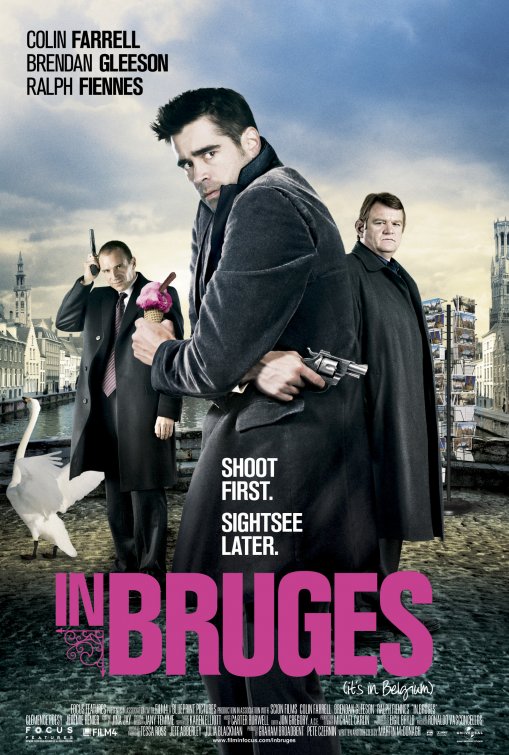
What an unexpected movie. In essence, Colin Farrel and Mad-Eye Moody play two hitmen, sent to Bruges by their boss (the hilarious Ralph Fiennes), for reasons I won't divulge here. It was marketed as a comedy, but it's not a comedy in the typical modern sense. The humour is found in the events that happen. Some of the "jokes" take the entire movie to play out. Most of the humour is inherent in how these characters talk. I'd always suspected "fuck" to be a flexible word, but I had no idea as to the dizzying heights it could truly reach.

This movie will not be for everyone, if only for the language, and a few moments of extreme-ish violence towards the end. But to focus on those things is to miss the point. This is as magnificently written movie as you'll see. McDonagh is a playwrite, and it shows. Like the best plays, nothing here happens that isn't addressed later. It not only holds up on subsequent viewings, it demands them, and it certainly rewards them. The third time I watched In Bruges, I decided to try and spot something that didn't get addressed in one way or another, and I ended up stumped. The characters are seemless, their relationships are explained in perfect, subtle ways, the events all relate, and the humour, though sparse, is very real. A great movie.

Grade: A

Saturday, June 20, 2009

I Take It to be a Good Omen...

Good Omens
Written by Neil Gaiman and Terry Pratchett

What do I take to be a good omen? This is the fiftieth post of the Thought's Dowinion relaunch! We made it everyone, and they never thought we would. Bastards, all of them. To be honest, there isn't any other book I'd rather be reviewing for this most auspicious of occasions than Good Omens. Finishing this is my own little victory over four years of efforts, false starts, and distractions. Mostly distractions. And false starts. Not so much with the efforts, to be honest. At least I'm not a liar.

As one would expect from Pratchett, this is a very, very funny book. The understanding I've gained is that Gaiman and Pratchett did the plotting over the phone on an almost daily basis, and, while Gaiman was primarily busy working on Sandman, Pratchett did most of the actual writing. I've never read any of his other novels, but they are now dutifily ready for the To Read list. It's funny, and I mean, it's really funny. I laughed frequently. It's a dry, English humour, no doubt, but it really is hysterical at times. The footnotes, my favourite literary device (I use them in papers all the time, when I know it wouldn't actually be appropriate to share what I want to share), had me in stitches, as they say. But humour alone is not enough.

What this does SO well, and moves it into the major leagues, is it tells a real and interesting story. Though it's almost impossible to imagine Good Omens without the jokes, as they are constant, it would be a great fantasy novel even without the wit. The story is that good, and that's what's missing from just about any lackluster comedy. There's no awkward difference when a section shifts from one writer to another; anyone familiar with his work can tell Gaiman was more involved with the plot, while Pratchett took care of editing everything down together. As far as fantasy/humour novels are concerned, this is in a league of its own. As far as fantasy novels go, it's still damn good.

Grade: A

Tuesday, June 16, 2009

And Now for Something Completely Different

White House Ghosts
(2008)
Written by Robert Schlesinger

While my interest in politics is mild at best, my interest in politically-themed entertainment is intense. The West Wing, Frost/Nixon, Charlie Wilson's War... the list goes on. I love fictional politics, and I love the stories around real politics. Combine with that my love for the English language, and it's fairly natural that I would pick up White House Ghosts, a history of presidential speechwriters, from FDR to GWB.

Its appeal is probably limited, but if you find it interesting, Schlesinger has done a great job. The research was undoubtedly exhaustive, with interviews conducted for over two years prior to release. History tends to be boring when it is delivered without a sense of story. There has to be some element of narrative to keep the audience engaged, lest it become a laundry list of dates and facts. What Schlesinger does so well, is he presents the history of the speechwriters while imbuing it with a story, one that keeps you interested without seeming forced. He clearly hasn't had to wrestle the facts into a story, they fit there well on their own, but you begin to see the ways administrations handled and mishandled their speechwriting staffs, how one presidency learned the lessons of the previous one, or discarded them altogether. It's a fascinating read, and by the end of this book, you will be amazed presidents ever manage to give speeches at all. I don't believe a book on this subject could have been written any better, or any deeper, without becoming droll.

Grade: A-

Wednesday Classics, Vol. 5: Pixar

With the recent release of Up, Pixar Animation Studios have reached their tenth movie, and I wanted to take the occasion to take a look back at the amazing track record John Lasseter's merry band have left behind them. There are ten reviews to write, so I'll forgo the lengthy introductory essay and get right to it.

Toy Story
(1995)
The template for every Pixar film was already firmly in place with the release of their first movie, Toy Story. It featured a score provided by Randy Newman (he would score Toy Story, A Bug's Life, Toy Story 2, Monsters, Inc., and Cars), state-of-the-art computer graphics, and a water-tight story, all of which have become Pixar trademarks. But what really makes it Pixar is the way the story is driven by the characters. Nothing in a Pixar movie happens just to have something happen; it all spins out of the characters and their motives, their relationships. By modern standards, it looks downright archaic, but Pixar's first film is still one of their best.
Grade: A

A Bug's Life
(1998)
An inconvenient hiccup of timing left A Bug's Life marked, in some circles, as a less intellectual, younger sibling to Dreamworks' Antz, released in the same season. That may be true, but they weren't aiming for the same audience. Antz was aiming for the adults, while A Bug's Life was for everyone. Toy Story suggested that Pixar had a way with slapstick, and they honed that sensibility here. Toy Story had a sophisticated edge to some of its jokes, and Pixar ran with the balance of humour for young and old here. The story and characters are strong as ever, and, while it may not measure up to most of the Pixar output, A Bug's Life is still a stellar achievement.
Grade: A-

Toy Story 2
(1999)
Toy Story 2 is a masterclass in writing a sequel. The continuity of the first film is preserved; we aren't given some half-baked excuse for a new adventure, it's logically built off of what's come before. The humour is still intact, and even developed. All the familiar characters from before have returned, and the new characters introduced neither outshine nor pale in comparison to the old guard; they feel as though they fit all along. We learn more about the histories of the characters; Buzz and Woody have their origins filled out in authentic, unforced ways. It's perfect, really.
Grade: A+

Monsters, Inc.
(2001)
I'm not sure how it works, exactly, but Pixar make their films in such a way that I am able to enjoy them simultaneously on both an artistic and a technical level. Yes, the story of Monsters, Inc. is clever and original. Yes, the characters are, as ever, strong. Yes, the sense of humour is there. But, my God, would you LOOK at that fur! Honestly. It was worth the cost of admission simply for the fur. It is not, objectively speaking, one of the stronger Pixar films, but it has a lot to live up to.
Grade: B


Finding Nemo
(2003)
Here we have what is widely considered the crown jewel of the Pixar empire. Finding Nemo actually is just as good as you've heard. It may even be better. The story, again, is water-tight (no pun intended), and the characters are wonderful. It speaks volumes for this movie that Ellen Degeneres was able to relaunch her career off the back of a voiceover role. It looks good, it's as colourful a movie as you'll ever see, and the relationships between the characters this time around are flawless. You can see Marlin growing fonder and fonder of Dory as the film progresses. In the Pixar canon, Toy Story 2 is the (relatively) unsung masterpiece, but Finding Nemo, thus far, is the studio's magnum opus.
Grade: A+

The Incredibles
(2004)
Brad Bird is responsible for this, and it shows. Bird has been around in animation for a long time, but he made his name with The Iron Giant, a masterpiece of animation that remains disconcertingly unfamiliar to the greater public. The Incredibles was written to be hand animated, but John Lasseter asked if Bird wanted to make it with Pixar. He said yes. A dramatic departure for the studio in tone and content, The Incredibles is one of their best films. It's more serious than the other Pixar movies. It has more to say about society; says Mr. Incredible, "They keep coming up with new ways to celebrate mediocrity!" The characters are defined, but subtle, and realistic. The motives are more complex than in any prior Pixar film, and, as a result, it is the most mature Pixar film, in every way. Not every animation studio would take a chance on a film like this.
Grade: A

Cars
(2006)
Every family has one, and most studios have several. The biggest "blemish" on Pixar's record is Cars, a film most animation studios would kill to make. It's not a surprise, though, and I'm disappointed Pixar didn't see it coming. Where Pixar has differed from every other studio is in, yes, I know, I keep saying, its characters, and that is the weakest link in Cars. The characters are enjoyable, and Tow Mater is the only thing Larry the Cable Guy should ever do, but they rely too heavily on stereotypes. The Volkswagon van is a stoner. The jeep is militaristic. Haha. Hoho. Now, I'm putting it down in relative light; it's a funny movie, it's never less than entertaining, and, as ever, it is well made. The stereotypes aren't so bad for a children's animated movie, but, by Pixar standards, it's for shame. You may ask yourself why there's a sequel in the works for their weakest film, and while I like to think it's because they feel like they could do better, it's hard to ignore the $5 billion in merchandise sales this film generated. Cars was a disappointment, but if the sequel isn't up to snuff, that will be the first blatant attempt at consumerism on Pixar's part, and that will truly break my heart.
Grade: B-

Ratatouille
(2007)
It's gotten to the point, with Pixar, where I hold my breath each time I hear about their next film. I keep waiting for The One, the irrifutably bad movie that will make them mortals, like any other studio. Before Brad Bird swooped in, at the urging of John Lasseter, Ratatouille was almost that film. During pre-production the previous director was removed, as the movie was not living up to the standards of Pixar. Bird was brought in, performed a major overhaul, and created an absolute gem of a film. It is the most visually sumptuous of all the Pixar movies, and marks a point of departure for the studio. The Incredibles aside, The Old Testament phase of Pixar was buddy comedies, with minor variations here and there. Ratatouille begins the New Testament, where Pixar started taking more chances with its stories. Given the results so far, I encourage the behaviour.
Grade: A

WALL-E
(2008)
Now the studio has balls. From Andrew Stanton, the director of Finding Nemo, we have the most unusual Pixar film. Consider a children's movie where the first half hour is practically silent. Consider an adult movie where that happens, even. WALL-E features two protagonists incapable of speaking much more than their names, but it never stops us from connecting. A powerhouse of animation, WALL-E's emotions are conveyed entirely through body language and "eye" movement. Again, he's got character. The story is involving and dramatic, and distinctly funny. If the environmental overtones are a bit too prominent, they don't distract from the story, and Pixar prove that risk-taking still makes for great movies.
Grade: A
Up
(2009)
Outside of the amazing rendering behind those balloons (the colours!), the trailer for Up had me less than excited. I was ready for this to be The One. When I saw it in theaters, the opening ten minutes put my fears to rest, and made me realise just how wrong I was. Those first ten minutes encompass everything that makes Pixar great; for one, there is some sublime slapstick comedy. For another, the childhood relationship between Carl Frederickson and his future wife is established quickly, effectively, and endearingly. There are no words spoken as we watch them live life together, nor as we watch her grow ill, and, ultimately, die. The first ten minutes of Up were more emotionally touching than anything I've seen in the last two or three years. The rest of the movie has all the trappings of a wonderful, New Testament Pixar movie; a slightly askew story, wonderful characters, and ample humour.
Grade: A

So, there you have it. The first ten Pixar films. All of them are classics of the medium, most of them are classic films regardless. The next Pixar venture is Toy Story 3. I'm nervous, as is my habit, that it will be The One. But then I saw the teaser trailer, which is nothing more than Woody, Buzz and the crew fashioning a logo for the movie; hearing Tom Hanks and Tim Allen voicing their roles again actually made me feel good. It was nice to hear the characters again, and I can't wait to see how they fair this time around. That's what Pixar does so well. In their best films, they create characters who become parts of your life, who feel more real in some ways than any real-life character ever could. Thanks to Pixar, animation isn't a genre anymore, it has risen to the level of Medium, through which any type of story can be told.

Monday, June 15, 2009

Art Brut Vs. Satan

Art Brut Vs. Satan
(2009)
Art Brut

I can't remember the last time an album made me laugh. I can think of some recent albums that have elicited wry chuckles, but no genuine laughter. Certainly not of an uncontrolled sort. The first time I listened to this album, I was at work, and I burst out in laughter during the song "DC Comics and Chocolate Milkshake," for reasons I won't reveal here. But it's wonderful. The whole album is clever. The lyrics are funny, but not in a detached way. In some ways, my appreciation for the emotions of the situations described are increased be Eddie Argos' refined sense of humour. The album ends with a song called "Mysterious Bruises," describing a night out that started with one Xanax, two Aspirin, and a drink that made him feel invincible. From an aural perspective, it's all post-punk-influenced angular guitars and upward tempos, with Argos using the same delivery throughout, a sort of shout. But it works. Musically, Art Brut are a one trick pony, but, my God, what a trick.

Grade: A-

Sunday, June 14, 2009

Actor
(2009)
St. Vincent

What an interesting year for women in pop this has been. I'm the first to admit my collection has an appalling under-representation of the fairer sex in its contents, but it thrills me that, so far, three of this year's strongest albums have all been the work of women. First, Lily Allen released the best strictly-pop album of the year with It's Not Me, It's You, which is still wonderful. Then, Yeah Yeah Yeahs released It's Blitz! Now, we have Actor, an album from an artist I have never heard of, St. Vincent. The first time I listened to this album, the musicality of it all escaped me, for reasons I don't know. The immediacy of the melody on opener "The Strangers" is so striking and wonderful that I can't understand how I missed it the first time through. It opens beautifully, with a strong melody and pretty underpinnings, only to have the whole thing ripped away to make room for a heavily distorted guitar. This is a pattern that the album will follow, with moments of beauty torn apart by moments of controlled chaos.

It takes a listen, apparently, but it's addicting. I listened to this album four times in a row the second time I listened to it, and it demanded more. No album has done that since The Good, The Bad, and the Queen came out three years ago, which, from me, is high praise. Actor is unlike anything I've ever listened to, at once beautiful while still challenging, and still operating in the broader umbrella of pop. Those who throw away the Pop umbrella lose my attention. Those who learn how to operate in their own corner of it tend to gain my greatest affections. St. Vincent is way out there on the fringe, but she knows exactly how to stay under cover. This may end up being the year's best album.

Grade: A

Monday, June 1, 2009

The Greats, Volume 2: Spoon

Based in Austin, Texas, Spoon are the ultimate Indie band. They've managed to break into the Top 10 on the Billboard Album Chart without feeling mainstream. Their music provided the soundtrack for Stranger Than Fiction, and brought them notoriety, but, again, they still feel like they belong to the audience. It's an impressive balance they strike, and it's in large part thanks to lead singer, guitarist, and song writer Britt Daniels. Spoon, make no mistake, is his band, and always has been.

First of all, a lot of their sound is owed to his voice, which I once heard described as a less-refined Billy Joel, and I'd be hard-pressed to improve on that. Just a touch rough around the edges at times, he brings emotion and urgency to the words and melodies, and is the heart and soul of their aesthetic. That, and his guitar, which is always just enough. His guitar lines are lean, effective, and angular. Perfect is another word.

Spoon's leader is Daniels, but no leader is without his lieutenant, and Britt has drummer Jim Eno (I always get his name scrambled in my head with Brian Eno and John Brion). The only other constant member of Spoon, he has a minimalist style that never draws attention to itself, but always reinforces the song. That's the part I like most about this band; everyone is in it for the song, not for themselves. Those are always the best ones.

A Series of Sneaks
(1998)
They came out of the gates with a simplicity and ferocity they'd never match, but, then, they haven't tried to repeat the post-punk, XTC-meets-Pixies template laid down here. As wrestless as any modern band, albeit in more subtle ways than, say, Radiohead or Wilco, they used their debut as a launching pad. But don't take that to mean it's lackluster. Spiky, and a grower, but so is their catalogue.
Grade: B+
Girls Can Tell
(2001)
They went from spiky to smooth, incorporating a sort of generalised 80's indie-rock influence. To try to dissect it would take too long, but, rest assured, it's good. While GCT contains the only outright bad song they've commited to tape ("10:20 AM"), it also comes with"Everything Hits at Once," which alerts us to Britt's occasional gifts as a lyricist: "Don't say a word, the last one's still stinging," the album begins.
Grade: B+
Kill the Moonlight
(2002)
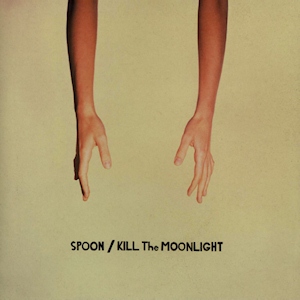
Here, Britt Daniels figured out what he wanted to establish as an aesthetic; write the song, and strip it of everything. Build around it a minimalist city that's still hooky, catchy, and can create something as essential as "The Way We Get By." Use keyboards where appropriate (re: everywhere), and put away the guitar from time to time. Is it an improvement? Maybe. But the best is yet to come anyway.
Grade: B+
Gimme Fiction
(2005)
They took that sparse thing and took it in its natural direction, towards the darkness. Sparse settings almost never want to be happy, and while "Sister Jack" and "I Summon You" are their finest pure-play pop songs, "The Beast and Dragon, Adored" is a heavy, heavy monster when they play it live. This one has to grow more than any of the others, but it's well worth it.
Grade: A-
Ga Ga Ga Ga Ga
(2007)
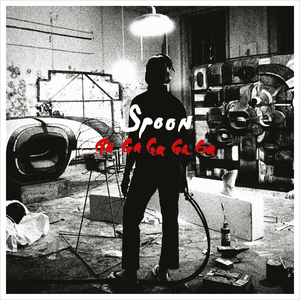
"Don't Make Me a Target" is surprisingly forward with its subject, but, with its raggedly brilliant chorus, Britt feels like he might, just might, be loosening up. "The Ghost of You Lingers" takes care of the experimentation, while everything after that does what they do best, only better. If the words meant more, it would be perfect. They get better with every album, and if this is the peak, they built one hell of a mountain.
Grade: A

Thursday, May 28, 2009

Catch up, Part 1

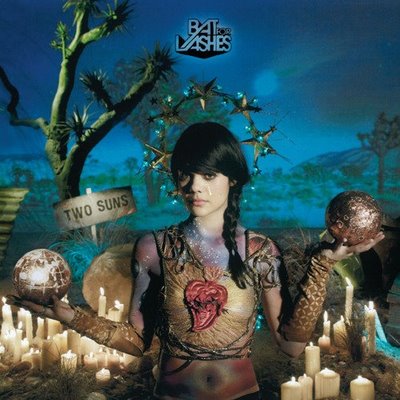
Two Suns
(2009)
Bats for Lashes

Opening track "Glass" is astounding, managing to be both propulsive and atmospheric, which is no small accomplishment. It's fair to say that describes the whole album, and that's unfortunate. The sound is so samey throughout that nothing develops its own identity, beyond that title track. The lyrics are nothing but empty brushstrokes to fill the canvas, which may well be the point, but her obfuscation isn't as effective as, say, Michael Stipe, or even Fur and Gold Bats for Lashes.
Grade: C

Together Through Life
(2009)
Bob Dylan

The trouble of evaluating Dylan on an even field is apparent; I feel a need to be perceived as "getting it" and a need to balance out all the faithful who will automatically give the album five stars. Fortunately, with Dylan, I long ago gave up the need to appear to "get it," and instead go with how I feel. Which works to his advantage here. Modern Times was a brilliant album, it was, and I've grown to appreciate it, but it was an intellectual exercise. It didn't feel like anything special at first. Fortunately for Bob, Together Through Life feels great. There's a swing. The songs are entertaining. If it's all a bit samey (noticing a trend?), it's a great, pastiche-like samey, one that reaches way back to the days when an accordion was a lead instrument. The lyrics are wry, predictable in the way where that's a compliment, and the voice is becoming a better instrument as he ages. His best? No. Calm down. But not so f
ar from it that I feel the need to balance.
Grade: B

Leftrightleftrightleft
(2009)
Coldplay

A free live album is cause for rejoicing, whether it's good or not. That this is exceptional, capturing the band in incredible form, on top of the world, is a plus. That it fills me with raging depression over having not seen them on this tour is actually a compliment. Is it essential? No. But bands shouldn't sound this studio-like live. Is it anything to write home about? Not really. Are you going to be converted if you weren't already? Of course not. Coldplay don't convert people. If you're a fan, will you love it? Yes.
Grade: A-

Friday, May 22, 2009

Someone Owes Banksy Some Money...

21st Century Breakdown
(2009)
Green Day

Do you remember when American Idiot came out, and everyone loved it? I do. I remember it. I bought the album the day it came out, and I even anticipated it. A friend of mine got an advanced copy, and she pumped me up for its release. It didn't disappoint. I listened to it on repeat for months. I even went as far as to learn the entire album on guitar. It was immediately after I'd started playing, and I had just bought my first electric, so the timing was right. It seemed set to be one of the important albums of my adolescence.

But something happened. My affection for the album decayed, and rapidly. I haven't listened to it in a year, at least. The last time I tried, I didn't make it more than twenty seconds into any of the songs. It's almost as though I've developed an allergic reaction. And I know I'm not the only one. What changed?

Whatever nagged me is still there. My enjoyment of Green Day in general has waned as I've aged, aside from my undying appreciation for "Basket Case." Perhaps this renders me unfit to review their newest offering, 21st Century Breakdown. On the other hand, it also allows me to objectively notice a few things. For one, I compliment their ambition. Say what you want, but, aside from Cage the Elephant, who may or may not prove to be of any importance, Green Day may be the only ROCK band aiming for the highest peak. They're certainly the leaders in their field, commercially, which was something no one expected from them at this point in their careers. And they've changed. American Idiot walked a line between what Green Day were and what they were contemplating becoming. Just because I'm not fond of what they've become doesn't mean they weren't brilliantly successful, and 21st Century Breakdown is the band committing to their new role, their new direction.

It picks up the "Concept Album" baton from American Idiot, and, of course, the story makes no sense. But that's part of the glory of their elite league, the lucky bastards. Whether you think the music deserves the stadiums of adoring fans, the millions of units shifted in a time when millions of units just don't shift, and the stellar reviews, or you think it's a disgrace to modern music, your opinion is now irrelevant, and so is mine. They are The Who of this decade, the dark horse pop band over in the corner who kept making their music bigger, because no one else noticed there was room for it. Kudos, boys.

Grade: A-

Tuesday, May 12, 2009

Crack the Skye

Crack the Skye
(2009)
Mastodon

I know for some of you it will take a moment to process that I even listened to this album. The grade I give it at the end may very well blow your mind.

As a result of this album, I listened to the rest of the Mastodon catalogue, and it is not for me. There is too much screaming. Of it's genre, I'm sure it's exemplary, but that's not something I can stomach in large portions. The amount it happens here is perfect for me, thank you very much.

What an album this is. I couldn't tell you any of the lyrics, aside from the very first line, "I flew beyond the sun before it was time." Apparently, from what I read, this album tells a story of a paralyzed boy traveling back in time and encountering Rasputin, who tries to steal the boy's body and come back to the present... or something like that. I don't know. It's inconsequential. Just listen to the music! They sing just enough to keep me interested, and there are some wonderful layers here. You hear more every time you listen.

Personally, my favourite is the slow burn of "The Czar," an 11-minute epic about nothing in particular (I think...). There is atonality everywhere, as there should be, and they handle it masterfully. This is what happens when a band on the fringes adds just enough of a popular ethos to their work; it is unique and true to their style while being entirely approachable to those on the outside. Is it for everyone? God, no. But it's for more than one would have thought.

Grade: A-

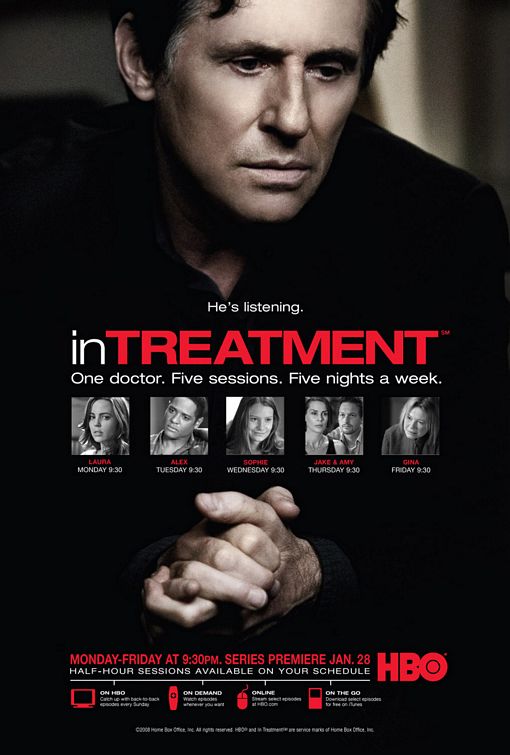
In Treatment

In Treatment: Season 1
HBO

I'm just now finishing the last two episodes of the first season of HBO's In Treatment. In short, it is a show about therapy. Gabriel Byrne plays Paul, a therapist with a private practice based in his house. For the first season, we are privy to four different sets of patients: Laura (Melissa George), a doctor who's been seeing Paul for a year before the show starts; Alex (Blair Underwood), a Navy pilot who comes to Paul after discovering that a target he hit was mistakenly identified as a terrorist stronghold when it was a school building; Sophie (Mia Wasikowska), a sixteen-year-old gymnast who needs a professional opinion from Paul after an accident; and, Jake (Josh Charles) and Amy (Embeth Davidtz), a couple trying to decide if they want another child. These episodes are delivered in week-long groups of five episodes. In the fifth episode of each week, Paul goes to see Gina (Dianne West), a retired therapist, becoming a patient himself.

You have to watch the whole season. You really do. Laura is irritating at first. Alex is arrogant and unlikable. Sophie's a brat, albeit an engaging one. Jake & Amy are the worst; their life seems like a soap opera, and they contain within themselves almost no personality whatsoever. Paul seems like a cool guy, until we learn he's a self-absorbed narcissist in the fifth episode. Consider that we start the show with all of these people in such a state, and, yet, by the end of the season, I'm sad to see everyone go. You spend 43 episodes getting to know all these individuals, getting to know everything about them. I know these people better than I know any of my friends. That's the idea, of course, and it's brilliant. I could never be a therapist. Getting to know people on such a level, and then having them just walk away, it would destroy me.

The information is given out in bits and pieces. You work for it. There are very few major revelations; only small ones. But there are many of them, and they are all staggering, and that is because they are all real. These are fictional characters, yes, but they are so thoroughly constructed, and so brilliant portrayed (It is easily the best across-the-board acting I have ever seen in any filmed medium), that you feel them as real. Week Nine is shorter, with only three episodes; two of them "wrap up" (I put it in quotes because this show is too wise to wrap everything up neatly, it only does so just enough to allow you to move on) Sophie's sessions and Jake & Amy's, and the third is a final session (for this season) with Gina. Throughout all three of those episodes, I was glued to the screen. I could not look away.

Television has rapidly reached a level of sophistication, to the point where I don't think anyone with an informed opinion can call it a lesser medium; it is capable of doing things a feature-length film could never (and should never) do. With shows like The Wire, intricate stories of incredible breadth and depth, with massive scope and huge, detailed casts, can be told without concern for overwhelming the audience. With shows like In Treatment, we can come to know and even care about people in ways that are impossible with only two hours of exposure. We are truly in the golden age, people. Soak it up.

Grade: A

Wednesday, May 6, 2009

Yes, Minister

Yes, Minister
BBC Television Series
1980-1984

I do love an English sense of humour. There exists a most unfortunate stereotype that Americans don't understand sarcasm, which is hardly fair; we as a mass simply don't enjoy sarcasm in our entertainment. A show like Friends, one that is often funny, but never in any sort of remarkable way, is much more to our liking as a nation. That the U.S. version of The Office has lasted as long as it has, and with the success it has had, is a miracle. We don't usually like humour we have to try and keep up with; we like it to bring us along at the same pace.

Yes, Minister wouldn't do well on this side of the pond. It's quick, it's witty, and you have to listen not only to what the people say, but how they say it. A lot of the jokes hinge on word play or quick, biting retorts. It's never prickly, though. It's not unpleasant. You never feel as though you're attempting to stomach something sour.

The funniest joke Friends ever produced was in the last episode; Central Perk, their coffee shop of choice for seven (?) seasons, has closed. One of the titular band asks if everyone wants to get coffee, prompting Chandler to ask, "Where?" In all the time we've known them, that question was never asked, because it never needed to be, and in that moment, Friends commented on itself, and acknowledged the formula. It took a while for it to get there, but it got there. What Yes, Minister does so admirably, over the course of the three series (there are an additional two series in the guise of a sequel, Yes, Prime Minister), is change. It does lock into a formula, but it begins to play with it and reference it. The initial episodes focus on the efforts of Permanent Secretary Sir Humphry Appleby to foil the plans of the Minister of Administrative Affairs, Jim Hacker, MP. Middle episodes involve Appleby and Hacker going toe-to-toe, each trying to subtly outmaneuver the other. By the third act, it's turned into a bizzare partnership. The whole time, we're treated to clever critiques of the British government, and wonderful character bits.

It's pretty easy to get the jokes, even if you don't understand how the government works. I got the hang of it after the first episode. And, as I said, it occupies a good middle ground. Well worth your time, this is an excellent program.

Grade: A